Sunday, November 22, 2009

Cultural Heritage of Samarkand

Introduction
Samarkand is unrivalled in terms of its architectural heritage, not only in Uzbekistan, but the whole of Central Asia. Once the capital of the Uzbek Soviet Socialist Republic (between 1925 and 1930), nowadays it is an important center for tourism and the second city of Uzbekistan (only behind the capital Tashkent in importance). The

Sher-Dor (Tiger) Madrassa is almost unique in Islamic architecture as it has depictions of living images on its façade.


Samarkand - Crossroads of Cultures
Ancient Arab manuscripts refer to Samarkand as the “Gem of the East”. In Medieval Europe it was known as “The City of Scientists”. A majestic and beautiful city, Samarkand is truly a city of legends. In 2001, UNESCO inscribed the 2,750-year-old city on the World Heritage List. Founded c.700 BC by the Sogdians, Samarkand was one of the major centers of their civilization, and by the time of the Achaemenid dynasty of Persia it was the capital of the Sogdian satrapy and was already a well established trading town when Alexander the Great captured it in 329 BC and was known as Maracanda by the Greeks.


As Samarkand grew it became a major centre on the caravan routes of Central Asia and over the next thousand years it became noted for embracing customs and ideas from all over Asia. Arab armies heading eastwards in the early 700s conquered the city and introduced Islam. Chinese armies heading westwards lost a battle near the city in the following century and Samarkand acquired paper-making techniques from captured soldiers, becoming the first place outside China to master this precious art.
By 1200, Samarkand was part of the great empire of Khwarizm and had become the most important  Centre for Islamic learning in all of central Asia. It was renowned for its scholarship, religious schools, and elegant Islamic architecture.
Sogdians


In 1220, the Khwarizm Shah provoked Genghis Khan by killing a large number of merchants under his protection. The Khans hordes of cavalry and thousands of siege engineers attacked and pillaged Samarkand, destroying the city and routing the population to such an extent that when Marco Polo visited 50 years later, the city had degenerated into a backwater. In 1370 another great conqueror Tamerlane decided to make Samarkand the capital of his empire, which in a short period he extended from India to Turkey. From 1370 to 1405, he built a new city, collecting skilled artisans from the countries he conquered and putting them to work as painters, bookbinders, and metalworkers. His grandson Ulugh Beg the famous astronomer (whose works were known in Europe during his lifetime) constructed in the 1420s a three storey tall sextant, one of the largest ever built. The ruins were rediscovered in 1908 and can be visited today. The city has an astonishing collection of ancient monuments.        
                                                                                                    Ulugh Beg
The city has an astonishing collection of ancient monuments.
The turquoise domes of Samarkand are among some of the Islamic world’s most evocative architecture. The most magnificent landmark in Samarkand is the Registan Ensemble and Square which are considered the traditional centre of the city. Registan Square is considered an architectural wonder representing some of the finest examples of Islamic Art in the world. The square is lined on the three sides by three sparkling and turquoise tiled madrasahs : Ulugbek Madrasah (1417-1420), the Sher-Dor (Having Tigers) Madrasah (1619-1636) and the Tilya-Kori Madrasah (1646-1660).On the western side is the oldest, the Ulughbek Madrasah, finished in 1420 and decorated with amazing mosaics depicting astronomical themes. Opposite is the Sher-dor Madrasah finished in 1636 and decorated with tigers. This is extremely unusual in Islamic Architecture as depiction of living creatures is normally considered idolatrous. In between is the beautiful Tilya-Kori Madrasah, which was only finally completed in 1660.                                                                                Registan Square at Night


Extensive restoration works have been undertaken to all three buildings. Inferior and exterior facades of the madrasah’s are decorated with an ornament of glazed brick, mosaic and carved marble. After the square the next most known site in Samarkand is that of the Gur-e-Amir Mausoleum (the burial place of Timur).It’s majesty of architectural forms and lines and colourful mosaic designs make it a unique monument of medieval architecture. It's famous blue ribbed cantaloupe dome rises over the tin roof-tops of central Samarkand.
 Ceramic Detail, Tilla Kori Madrassa,Registan Square
 A massive slab of green jade, under which Tamerlane was laid, is said to be the largest such piece of Jade in the world. Another masterpiece the beautiful mosque of Bibi-Khanym is also the stuff of legend. One story says this gigantic ruined mosque was started by Tamerlane’s Chinese wife, Bibi-Khanym, while he was away campaigning in India. It is said that the architect fell for her and refused to complete the building until she gave him a single kiss. The kiss (and maybe more beside) ensured that upon returning Tamerlane ordered them both killed.
Magnificent interior of the dome of the  Gur e Emir Mosque (above Timurs Tomb)
The cupola of the main chamber rises up to 40 m. The mosque was still under construction in 1399 after Tamerlane's return from his conquest of India, according to the writing's of the then Spanish Ambassador Ruy Gonzáles de Clavijo, who reported that 90 captured elephants were employed merely to carry precious stones, to erect the mosque. Its construction was completed in 1404 and for a number of years the mosque was the most prominent in Samarkand, however it slowly fell into disuse, and crumbled to ruins over the centuries.
 Its demise was hastened due to the fact that its builders had constructed it too quickly and had pushed the building techniques of the time to the very limit. Another fascinating site is that of the Shah-i-Zinda, a huge burial complex on a hill opposite the heart of the old town. It is referred to as “the street of the dead”, and comprises many mausoleums and tombs, all covered Shah-i-Zinda
with spectacular turquoise tiles. The name Shah-i-Zinda (meaning "The living king") is connected with the legend that Kusam ibn Abbas, the cousin of the prophet Muhammad was buried there. Coming to Samarkand with the Arab invasion the 7th century to preach Islam.


Later History  In 1500 the Uzbek nomadic warriors took control of Samarkand. The Shaybanids emerged as the Uzbek leaders about this time and in the second quarter of 16th century moved their capital to Bukhara and Samarkand went into decline. After an assault by the Persian king, Nadir Shah in 1720 the old city once again fell into ruin. In 1868 Samarkand came under Russian rule after the citadel had been taken by a  force under Colonel Kaufman. In the following years the Russian section of the city started to emerge largely to the west of the old city.  In 1886, the city was made the capital of the newly formed Samarkand Oblast and grew in importance still further when the Trans Caspian railway reached the city in 1888. After the revolution it became the capital of the new Uzbek SSR before being replaced by Tashkent in 1930. Today it is the second city of the Republic of Uzbekistan and is a magnet for tourists from all over the world who come to see its magnificent Islamic architecture.

Monday, November 16, 2009

Photograps of the Aral - A salute to Pavel Kosenko - A Really Brilliant Photographer!

KUNGRAD Soda Ash plant


KUNGRAD Soda Ash plant

After 4 year construction period starting in 2002 the Kungrad Soda Ash plant was commissioned in August 2006.

The plant, a joint venture between Chinese group China International Trust & Investment Company International Cooperation Company and Uzbekistan's UzKimyoSanoat (a major Uzbek chemical industry conglomerate) cost US$100 million to build and occupies 60 hectares, The plant has a projected production capacity of 100,000 tonnes of soda ash yearly.

Citic Pacific Ltd carried out the design and turn-key construction of the technological side of the plant (cost US$32.3 million) funded by a loan of the Industrial and Commercial Bank of China (90% of the contract cost) with the insurance provided by the Chinese Export and Credit Insurance Corporation, and a loan of the UzPromStroyBank (Uzbek Industrial Construction Bank, 10% of the contract cost) guaranteed by the Uzbek government.

General construction works were performed by local construction companies for UzKimyoSanoat.

The production of Kungrad Soda Plant covers domestic demand and export sales of soda ash, hydrate of sodium, and table salt.

Uzbekistan's current domestic demand for soda ash is 60,000-70,000 tonnes yearly.

The main consumers being the household chemical industry and the producers of construction materials and glass makers.

The resource base for Kungrad Soda Plant is the Barsakelmes salt deposit (explored reserves estimated at 131 million tonnes of common salt containing 97% of NaCl) and the Jamansay limestone deposit (explored reserves estimated at 70 million tonnes) both located in the north of Karakalpakstan near the industrial city of Kungrad.

They are currently producing 240-250 tons a day of high-quality product (equivalent to 85,000 tons of soda a year). The plant employs 1,300 people (making it the largest industrial employer in the Republic). Among the main buyers of the plant's products are the companies Quartz, PharmGlass, Gazalkent Oyna, Uzqurulishmateriallari, Uzkimyosanoat and Uzbekneftegaz.

It is on target this year (2009) to export over 36,000 tons of soda to overseas buyers in Russia, Kazakhstan, Kyrgyzstan and Turkmenistan. Clients to date have included the Bryansk Chemical Company (Russia), Maylisuu Electric Lamp Plant (Kyrgyzstan), Power Global Engineering (Kazakhstan) and Letreh Invest (Turkmenistan).


Source:http://www.south.citic.com

Friday, November 13, 2009

The Origins of Algebra - al khorezmi


Al khorezmi

The first treatise on algebra was written by Diophantus of Alexandria in the third century AD. The term derives from the Arabic al-jabr or literally "the reunion of broken parts.'' As well as its mathematical meaning, the word also means the surgical treatment of fractures. 'the setting of broken bones'.  Algebra gained widespread use through the title of a book " ilm al-jabr wa'l-mukabala - the science of restoring what is missing and equating like with like".

Written by the mathematician Abu Ja'far Muhammad (active c.800-847), who subsequently has become know as al-Khwarazmi, the man of Khwārazm. The words Algorism (the Arabic or decimal system of writing numbers) and algorithm also both derive from his name.

Abu Jofar Mohammed ben Musa al Khorezmiy al Majusi al-Katrabbuli (Muhammad ibn Musa al-Khwarizmi) was born in 783 in Kath located on the outskirts of Beruni in Southern Karakalpakstan.

In 809, he left for Merv to become a scholar at the court of Al-Mamun, the ruler of the Eastern province of the Caliphate and a famous patron of the arts and sciences. On Al-Mamum assuption of the Caliphate in 819 he followed his patron to Bagdad where he was nominated him head of the House of Wisdom, the first and largest scientific center of the Middle Ages, later called the "Academy of Al-Mamun".

Here from 829 Mohammed Al-Khorezmi wrote more than twenty research works, the most famous of which is the "Concise Book of Calculus in Algebra and Almukabula". It was translated into Latin in the twelfth century; its Arabic and Latin variants have been preserved. Al-Khorezmiy wrote "A Book of Indian Calculus", a work known in the Latin version translated by Adelard Bat in the 12th century; he also wrote the Zij - renowned astronomical tables. The tables were translated into Latin, and those Latin manuscripts remain preserved. Al-Khorezmiy also wrote "The Book of Survey of the Orient" represented by the one and only Arabic manuscript in Strasbourg, France. The manuscript was re-copied in 1037. Fragments of his "Book of history" in Arabic still exist.
 
Al Khawarizmi was the founder of several basic principles of mathematics. In his "Book of Indian Calculus" he for the first time in science, describes the arithmetical operations of decimal positioning, based on nine digits and zero. His publication spread the concept of zero across the world. He was also the first to describe the concept, written in Latin language of the "algorithm" which signifies "a constant calculating process". Algorithm is one of the basic concepts not only of mathematics, but also cybernetics.

In another book Al-Jabr wa-al-Muqabilah (Book of Calculations, restoration and reduction) is where the word algebra (Al Jabr in Arabic) was first used. Al-Khorezmi was also the first scientist to define and represent algebra as a science. In his work he submitted six canonical types of linear and square equations and basic methods of solving them, methods which are still used.

The word "algebra" was latinised from the Arabic word "al-jabr", which is evident from the Arabic title of the treatise. The word stands for "filling in" - one of the fundamental operations in algebra at that time.

These works tremendously influenced the development of Science in both the Muslim World and in Europe making him one of the most important mathematician, astronomer and geographer of his age.

Source: Wikipedia http://en.wikipedia.org/wiki/Mu%E1%B8%A5ammad_ibn_M%C5%ABs%C4%81_al-Khw%C4%81rizm%C4%AB and  www.orexca.com/p_khorezmiy.shtml

Al Beruni - Great Scientist and Physicist


Al Beruni

Abū Rayḥān Muḥammad ibn Aḥmad Bīrūnī often known as Alberuni, Al Beruni or variants, was born on the 5th September 973 in Kath in what was then the state of Khwarezm (now the town of Beruni in Southern Karakalpakstan) and died on the 13th December 1048 in Ghazni, in today's Afghanistan.

He was a scientist and physicist, an anthropologist and comparative sociologist, an astronomer and chemist, a critic of alchemy and astrology, an encyclopedist and historian, a geographer and traveler, a geodesist and geologist, a mathematician, a pharmacist and psychologist, an Islamic philosopher and theologian, scholar and teacher.

Al Beruni was the first Muslim scholar to study India and the Brahminical tradition, and has been described as the founder of Indology, the father of geodesy, and "the first anthropologist".

He was also one of the earliest leading exponents of the experimental scientific method, and was responsible for introducing the experimental method into mechanics and mineralogy, a pioneer of comparative sociology and experimental psychology, and one of the first to conduct elaborate experiments related to astronomical phenomena.

Two important scientific chroniclers George Sarton, who described Biruni as "one of the very greatest scientists of Islam, and, all considered, one of the greatest of all times." and A. I. Sabra as "one of the great scientific minds in all history."

The crater Al-Biruni on the Moon is named after him. Tashkent Technical University (formerly Tashkent Polytechnic Institute) is also named after Abu Rayhan al-Biruni as is a technical university in Kapisa, Afghanistan.

Source: Wikipedia see http://en.wikipedia.org/wiki/Ab%C5%AB_Ray%E1%B8%A5%C4%81n_al-B%C4%ABr%C5%ABn%C4%AB for more information.

Thursday, November 12, 2009

Ibn Battuta in Khorezm and Bukhara

Ibn Battuta

Ibn Battuta was the greatest Arab traveller of the Medieval times. Leaving his native city Tangier in 1325, at the age of twenty-one, he travelled to East Africa, Byzantium, Iraq, Southern Russia, Central Asia, India, Ceylon, Sumatra and China for 29 years, covering 120 thousand kilometres, getting as far north as the Volga, as far East as China and as far South as Tanzania. Ibn Battuta travelling in an era the beginning of the fourteenth century when Muslim rule had been spread over a large part of India, the Middle East and North Africa and had established a footing in China.

KHOREZM

In the autumn of 1333 Ibn Battuta arrived in Khorezm. The city having recovered from the devastation left by the Genghis Khan hordes. "Life is thriving in the city thanks to a large number of residents, and it looks like a billowing sea" He had just spent 30 days crossing the desert after leaving Sultan Uzbek's brand new capital of Saray al-Jadid on the Volga.

He was clearly impressed: " ... we arrived at Khorezm [Urgench] which is the largest, greatest, most beautiful and most important city of the Turks. It has fine bazaars and broad streets, a great number of buildings and abundance of commodities; it shakes under the weight of its population, by reason of their multitude, and is agitated by them in a manner resembling the waves of the sea. I rode out one day on horseback and went into the bazaar, but when I got halfway through it and reached the densest pressure of the crowd at a point called al-Shawr [the crossroad], I could not advance any further because of the multitude of the press, and when I tried to go back I was unable to do that either, because of the crowd of people. So I remained as I was, in perplexity, and only with great exertions did I manage to return."

The city had a new college (medresseh), recently built by its governor Qutlugh Timur in which Ibn Battuta stayed, a cathedral mosque built by the Amir's pious wife – the Khatun (queen) Turabeg, a hospital with a Syrian doctor, and a nearby hospice built over the tomb of Najm al-Din Kubra.

The city's residents also impressed Ibn Battuta: "Never have I seen in all the lands of the world men more excellent in conduct than the Khorezmians, more generous in soul, or more friendly to strangers."

The local people were also extremely pious, possibly because the muezzins of each mosque would visit the neighbouring homes and remind them that the hour of prayer was approaching. The imam would fine those who failed to attend and beat them with a whip, which was prominently displayed in the mosque as a reminder!

The city was close to the Jaiyhun River [then the main channel of the Amu Darya, now the Darya Lyk], which was navigable by boat in the summer, the journey to Termez taking 10 days.

He also received hospitality from the Sufi Order of Ahi and stayed in zaviya (Sufi tenements) where pilgrims, were warmly welcomed.

Also mentioned were a surgery where a Syrian doctor worked, and he wrote in detail about a zaviya not far from Khorezm, near the tomb of Sheikh Najm ad-Din al-Kubra. In the house of the doctor Kadi Abu Hafs Umar he was amazed by the beautiful carpets the central hall was decorated with, and the cloth-upholstered walls with numerous recesses where gilded sliver vessels and Iranian jugs stood.

Ibn Battuta also visited the Emir whose house, along with the sumptuous feast, he described in detail. He also emphasized the piety of his new acquaintances and the extravagant gifts they lavished on him: a large sum of money, a sable overcoat and a beautiful stallion.

He also mentioned that he especially admired were Khorezmian melons: '… there are no melons like Khorezmian melons, may be with the exception of Bukharian ones, and the third best are Isfahan melons. They are the best of all dried fruit.'......' Their peels are green, and the flesh is red, very sweat and hard. Surprisingly, they cut melons into slices, dry them in the sun, put them into baskets as it is done with Malaga figs, and take them from Khorezm to the remote cities in India and China to sell'

(ED: The melons grown in Western Uzbekistan are also the best I've ever tasted....)

From Khoresm, Ibn Batuta made his way to Bukhara by camel. It took 18 days. Most of the way from Urgench to Vabkent (an old settlement near Bukhara). The trip was very difficult for Ibn Battuta party as a result of the scorching sun, lack of water and good forage for camels, which were extremely exhausted by the time they reached there destination.

BUKHARA

Medieval Bukhara was one of the most famous cities in the Islamic world, and many Arab geographers described its splendor.

However, Ibn Battuta saw Bukhara in a sorry state: 'This city had once been the capital of the cities lying across the Jaihun River, but the cursed Tatar Tinghiz (Genghiz Khan)… destroyed it so that all of its mosques, madrasahs and market-places lay in ruins, with a few exceptions. Its residents are humiliated, and their testimony is accepted neither in Khorezm nor in any other country ......'

Bukhara the once-great walled city that tried to resist the Mongols had been almost totally destroyed, by them in 1220 however it was starting to come back to life by the time Ibu Battuta visited the city.

He stayed in Fathabad, a suburb of Bukhara, where there was a large zaviya and a mausoleum, which struck him by its dimensions, near the tomb of a sacred hermit Saif at-Din al-Baharzi. The Sheikh of the Zaviya invited Ibn Battuta to his place, as well as all notables of the city, and here, '.... reciters read the holy Koran in their pleasant voices, while the preacher made a sermon. They sang wonderful songs in Turkic and Persian. That was the most wonderful night of all nights'

And there are a lot of such excerpts in the manuscript, that is why the book is considered a masterpiece of "rihla" - geographic description of a country a traveller saw with his own eyes. Biographies of historical personalities often contain data that cannot be found in other sources.

When Ibn Battuta visited the city in 1333, he reported that all but a few of its buildings still laid in ruins, and had a poor view of the people of Bukhara saying that ,"there is not one of its inhabitants today who possesses any theological learning or makes any attempt to acquire it."

But before its destruction by Genghis Khan in 1220, Bukhara deserved its reputation as a city of pious scholars. In the tenth century, under the rule of the Samanids, it became known as a centre of Islamic learning, and established a reputation that survived succeeding centuries of scholarly darkness. Bukhara had wide paved streets and a population of 300,000. Its 250 madrasahs attracted students from as far away as Arabia and Spain. One such scholar Ismail al-Bukhary who was born in 810 in Bukhara, has been renowned in Muslim world for 1000 years as the author of the hadithses "AI-Djami as-salih", or literally in English Book "Trustworthy", which is the second most important Muslim text after the Koran

Its most famous son of Samanid Bukhara was Hussain ibn Abdullah ibn-Sina, known to the West as Avicenna (whose name became the basis of the word medicine), who wrote his famous medical encyclopaedia there, making the city renowned in the Islamic world. But all that was lost when the city was overrun in 999 by the Qarkhanids (Uighurs).  Avicenna himself fled, and wandered the Islamic world for most of the rest of his life. No buildings of the Samanids remain, except, appropriately, a mausoleum.

During the next century of turmoil, however, there must have been some continued respect for learning, or at least for architecture, because it was during that time that the tall and exquisitely beautiful Kalon minaret was built, to call the faithful to prayer five times a day, to serve as a signal tower at night, and to give notice to travellers that this was a city of pious Moslems. And certainly there was a fine city there when the Khorezmshah, ruler of Bukhara, Samarkand, and Khiva/Urgench, gave grave and deliberate offense to Genghis Khan. First, he executed as spies some 450 Mongol merchants. Then, when Mongol ambassadors were sent to seek reparation, he had one of them killed and shaved the beards of the rest. (ED: Ambassadors didn't always have protection).

In retribution, as the Khorezmshah might have expected if he'd known the Khan just a little bit better, Genghis pounded Samarkand into dust and reduced Bukhara to a level plain. "I am the scourge of God," he proclaimed in Bukhara. "If you had not committed great sins, God would not have sent a punishment like me."

He spared only the intricately worked Kalon Minaret, the Tower of Death, from which prisoners were thrown to their deaths. Much of the rest of the once-great walled city that tried to resist the Genghiz Khan's Mongol army however was all but totally destroyed.

Kalon Minaret

On taking Bukhara Genghiz Khan had conquered the largest empire in recorded history, two-thirds of the population of Central Asia lay dead, and other cities like Farah, Urgench, Ghazni, Bamian, and Balkh were in ruins.

So much was destroyed by the Mongols in 1219 and by other Tatar armies in 1273, and 1316. It was said that in the aftermath of the conquest, civilization did for a time simply vanish.

Ibn Battuta reported that 'the mosques, colleges, and bazaars are in ruins ...' . Bukhara only started to come back to its former life some fifty years after Ibu Battuta visited the city when the great Tamerlane started to rebuilt the city, from about 1390. In time he and his decedents in the succeeding centuries were once again to turn the city into one of the most magnificent in all of Central Asia.

TRAVELS

A few years after Ibn Battuta's return to Tangiers, the Sultan of Morocco commissioned a young writer, Ibn Juzayy, who had enjoyed Ibn Battuta's tales, to record the traveller's memoirs.

The result was the book 'A Gift To Those Who Contemplate The Wonders of Cities and The Marvels of Traveling,' or 'Travels' (Rihalah) for short.

The manuscript presents a realistic picture of political, public and cultural life of the many places he visited in the first half of the 14th century and is considered to be one of the most descriptive geographic pieces of literature to come out of the Middle Ages.

Ibn Battuta's book had a steady readership over the centuries in the Muslim world. European orientalists had heard of the' Travels' by about 1800.

An abridged Arabic version done in 17th century was translated into English by Reverend Samuel Lee and published in 1829. Several full texts of Rihalah were found and between 1893-1922 it was edited and published in Arabic/French in four volumes by Defremery and Sangunetti in Paris (Imprimerie Nationale). Further translation into English was commenced by H A R Gibbs in 1929, who completed the first three volumes. The translation of volume 4 was completed by H A R Gibbs and C F Beckingham in 1994.

Source: http://en.wikipedia.org/wiki/Ibn_Battuta
             

Konya Urgench (Old Urgench)


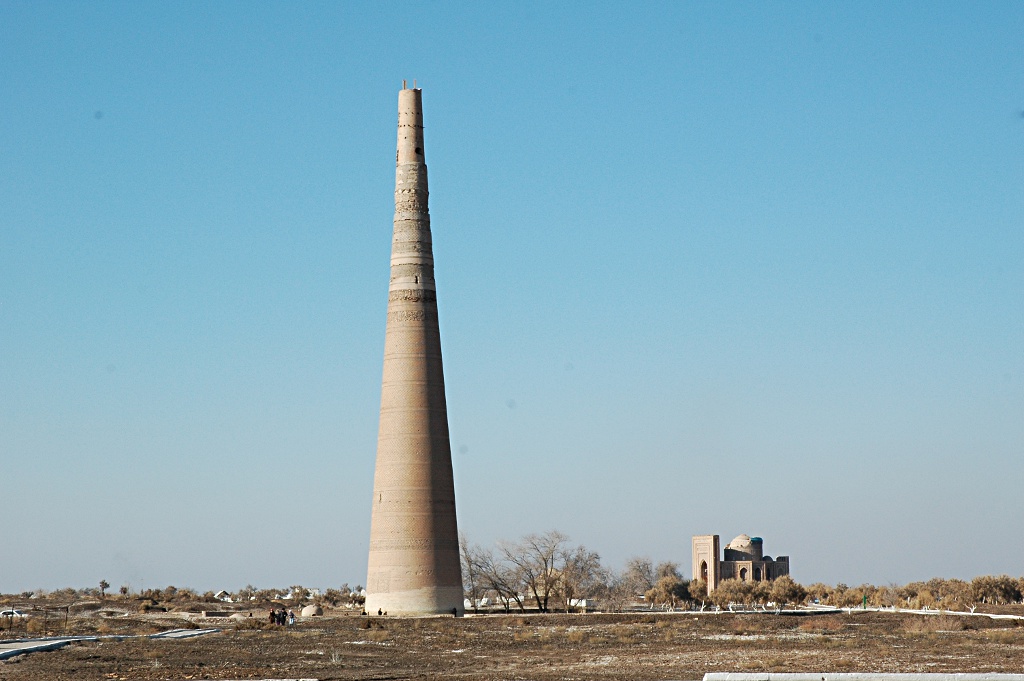
Gutluk-Temir Minaret

FROM WIKIPEDIA

Konya-Urgench, Old Urgench or Urganj (Turkmen: Köneürgenç, Russian: Куня Ургенч, Persian Kuhna Gurgānj) lies some 43km west southwest of No'kis, just across the border in Turkmenistan. The city contains the largely unexcavated ruins of the once famed 12th century AD capital of Khwarezm. Today it is the capital of a district of the same name with some 30,000 inhabitants. Since 2005, the ruins of Old Urgench have been protected by UNESCO as a World Heritage Site.

Formerly situated on the Amu-Darya River, Konya-Urgench (the Urgench) was one of the greatest cities on the Silk Road. Its foundation date is uncertain, but the extant ruins of the Kyrkmolla fortress have been dated to the Achaemenid period. The 12th and early 13th centuries were the golden age of Urgench with it surpassed in population and fame all other Central Asian cities barring Holy Bukhara.

In 1221, Genghis Khans armies razed it to the ground in one of the bloodiest massacres in human history, killing almost the entire population. Urgench however recovered in time and once again became a thriving commercial centre and a staging post on the important trading route between Europe and the Black Sea ports in the west and Mongolia and China in the east.

In 1388 the whole city was again destroyed by Timur, as were most other parts of Khorezm. Timur's campaign was not only aimed at eliminating the military threat posed by Khorezm and the remnants of the Khanate of Qipchaq, but also at destroying an important commercial and cultural competitor. As such, most of the city was deliberately demolished. The historian Ibn Arabshah reported that after ten days of destruction, only the mosque and its minarets were left standing. Timur is reported to have ordered that the ground on which the city stood should be ploughed and sewn with barley.

The city was partly rebuilt in the 16th century, but it was largely abandoned when the Amu-Darya changed its course. Timur's armies destruction of the dams controlling the flow of the Amu Darya meant the river was now free to revert to its natural direction of flow – towards the Sarykamysh Lake. The level of the Aral Sea began to fall and the Amu Darya delta began to dry out forcing its nomadic population to migrate. It was the beginning of an environmental crisis that would last for over 200 years.

The modern city of Konye-Urgench dates from the construction of a new canal by Tsarist Russia in the 19th century. Today, most of the city of Old Urgench lies underground, but there is enough signs to get an idea of its former glories. Its uniqueness was acknowledged in 2005 when Unesco named it as a World Heritage site.

The most striking monument of old Urgench is the early 11th-century Gutluk-Temir Minaret, which, at 60 meters and prior to the construction of the Minaret of Jam (located in Ghor Province in Afghanistan) was the tallest brick minaret in the world. Notably the one structure that both the Mongols and Timur spared destruction.

Also of note is the Il-Arslan Mausoleum - the city's oldest standing monument: a conical dome (with 12 facets) housing the tomb of Mohammed II (the ruler of the Khwarezmid Empire from 1200 to 1220) and three other smaller mausoleums dating from the 12th century including the elaborate 14th-century Törebeg Hanym Mausoleum, which was restored in the 1990s. Somewhat to the north of the old city sprawls a vast medieval necropolis that is also well worth visiting.

Source: http://en.wikipedia.org/wiki/Konye-Urgench

FROM LONLEY PLANET

The modern town of Konye-Urgench (from Persian ‘Old Urgench’) is a rural backwater with empty plazas, wandering livestock and back roads that end in agricultural fields. Yet centuries ago, this was the centre of the Islamic world, not the end of it.

The ancient state of Khorezm, located on a northerly Silk Road branch that leads to the Caspian Sea and Russia, was an important oasis of civilisation in the Central Asian deserts for thousands of years.

Khorezm fell to the all-conquering Seljuq Turks, but rose in the 12th century, under a Seljuq dynasty known as the Khorezmshahs, to shape its own far-reaching empire. With its mosques, medressa, libraries and flourishing bazaars, Gurganj became a centre of the Muslim world, until Khorezmshah Mohammed II moved his capital to Samarkand after capturing that city in 1210.

Jenghiz Khan arrived in 1221, seeking revenge for the murder of his envoys in Otrar as ordered by Mohammed II. Old Urgench withstood the siege for six months, and even after the Mongols broke through the city walls the residents fought them in the streets. The Mongols, unused to cities, burnt the houses but the residents still fought from the ruins. In the end, the Mongols diverted the waters of the Amu-Darya and flooded the city, drowning its defenders.

The Mongol generals went in pursuit of Mohammed II who eluded them for months until he finally died of exhaustion in 1221 on an island in the Caspian Sea. The tombs of his father, Tekesh, and grandfather, Il-Arslan, survive and are two of Old Urgench’s monuments.

In the following period of peace, Khorezm was ruled as part of the Golden Horde, the huge, wealthy, westernmost of the khanates into which Jenghiz Khan’s empire was divided after his death. Rebuilt, Urgench was again Khorezm’s capital, and grew into what was probably one of Central Asia’s most important trading cities – big, beautiful, crowded and with a new generation of monumental buildings.

Then came Timur. Considering Khorezm to be a rival to Samarkand, he comprehensively finished off old Urgench in 1388. The city was partly rebuilt in the 16th century, but it was abandoned when the Amu-Darya changed its course (modern Konye-Urgench dates from the construction of a new canal in the 19th century).

Today, most of Old Urgench lies underground, but there is enough urban tissue to get an idea of its former glories. Its uniqueness was acknowledged in 2005 when Unesco named it a World Heritage site. The modern town is somewhat short on tourist facilities and most travellers overnight in Dashogus.


Read more: http://www.lonelyplanet.com/turkmenistan/northern-turkmenistan/konye-urgench#ixzz2zZqFrsji