Monday, September 30, 2013

Made in Uzbekistan (Part 2) Introducing Uzbek-American joint venture GM Uzbekistan's new car model Chevrolet Cobalt


GM Uzbekistan (formerly JSC UzDEUavto Asaka) has began production of a new car model the Chevrolet Cobalt. It is equipped with a DOHC gasoline engine, 1.5 litre cylinder capacity and 106 horsepower output, combined with a five-speed manual transmission. It has good fuel economy up to 6.2 litres per 100 km.  Output from the plant is expected to be up to 125 thousand vehicles per year, sales to both Uzbekistan and throughout the CIS.

JSC UzDaewooAuto was established in 1996 on a parity basis by the Government of Uzbekistan and South Korea's Daewoo Motors. In 2005 Uzbekistan Daewoo bought shares in the joint venture.

In 2007 Uzavtoprom and General Motors signed an agreement to establish a basis for the GM Uzbekistan plant with charter capital of $266.7 million. General Motors owns 25 per cent of shares plus one share in the enterprise, with the possibility of increasing it to 40 per cent. Currently, 75 per cent of the shares belong to Uzavtoprom.

The Joint Venture currently produces eight models of cars, four of which are manufactured using  SKD*1 technology (Chevrolet - Captiva, Epica, Spark and Malibu). 

See Video in Russian performance drive of Cobalt near Samakand.

http://www.youtube.com/watch?v=60d3wMIGyk8

Chevrolet Captiva (since 2008)
Chevrolet Epica (2008 - 2011)
Chevrolet Lacetti (2008 - 2013)
Chevrolet Spark M300 (since 2010, both  export and for local market)
Chevrolet Tacuma (since 2008 - 2009)Chevrolet Cobalt (since 2012)


Note:  *1 - SKD is the abbreviation of the term Semi Knock Down. Where the exporter sells the product by SKD and they are then assembled in the host country. An original equipment manufacturer, or OEM, manufactures products or components that are purchased by another company and retailed under that purchasing company's brand name. OEM refers to the company that originally manufactured the product in this case Chevrolet.

Made in Uzbekistan (Cars) - Part 1

Thursday, September 12, 2013

Kazakh cuisine in Karakalpakstan

Some 400,000 citizens of Uzbekistan who identify as Kazakhs live in the republic of Karakalpakstan,  Most are descendants of the "Junior juz" (Kişi juz).

For hundreds of years Kazakhs traditionally lived as nomadic herders who raised fat-tailed sheep, camels, and horses, relying on these animals for transportation, clothing, and food. The amount of cooking equipment used was minimal as traditionally it was transported from location to location to follow the grazing herds. The iron “Qazan” was and still is their most indispensable piece of cookware used for cooking pilaf’s, soups, and even bread (it can be turned over to cook flatbread on the back).

Kazakhs traditionally eat at a low table called a “dastarkhan”.  They also maintain a tradition of using beautiful dishware when possible. Traditional beverage Kumis is laden into wide bowls decorated with silver or in painted cups, and meat is served on wide platters. Tea is steeped in ornate teapots and served in decorated cups.

In Kazakh practice the guest is always given a place of honour at the table and a special welcome in the household. On special occasions the  most honoured guest at a meal will receive a cooked head of a ram or a goat which is passed around in ceremonial or ritual practice. 

Main Dishes

Besbarmak, a dish consisting of boiled meat, is the most popular meal in Kazakh homes. It is also called “five fingers” because of the way it is eaten. The chunks of boiled meat are cut and served by the host in order of the guests’ importance. The boiled meat eaten with thin boiled pieces of pasta sheet and a meat broth called shorpa, and is traditionally served in bowls called “kese”. The host of the meal cuts the meat himself (or herself) and by tradition the best cuts are given to the more honoured people.

Another favourite is Manti a spiced mixture of ground lamb (or beef) spiced with black pepper, enclosed in a dough wrapper. Cooked in a multi-level steamer and served topped with butter, sour cream, or onion sauce.

A very popular dish for Kazakhs as with other people living in Uzbekistan and other parts of Central Asians is Palaw (Pilaf) which is made from meat fried with carrot and onion or garlic then cooked with rice.

Traditional Sausage is also very popular in Kazakh cuisine. One favourite is Kylmai a sausage made from ground meat, mixed with salt, herbs, and other spices, although vegetarian sausages are available. Made during winter and fall slaughtering and is made by stuffing intestines with pieces of ground meat, fat, blood, garlic, salt, and pepper. It will last a long time if it is smoked. Other popular sausages include Koten is a sausage eaten in the spring when a cow has a new calf; it is a giant sausage sometimes served with rice or kurt. Also kazy and shuzhuk made from horsemeat.
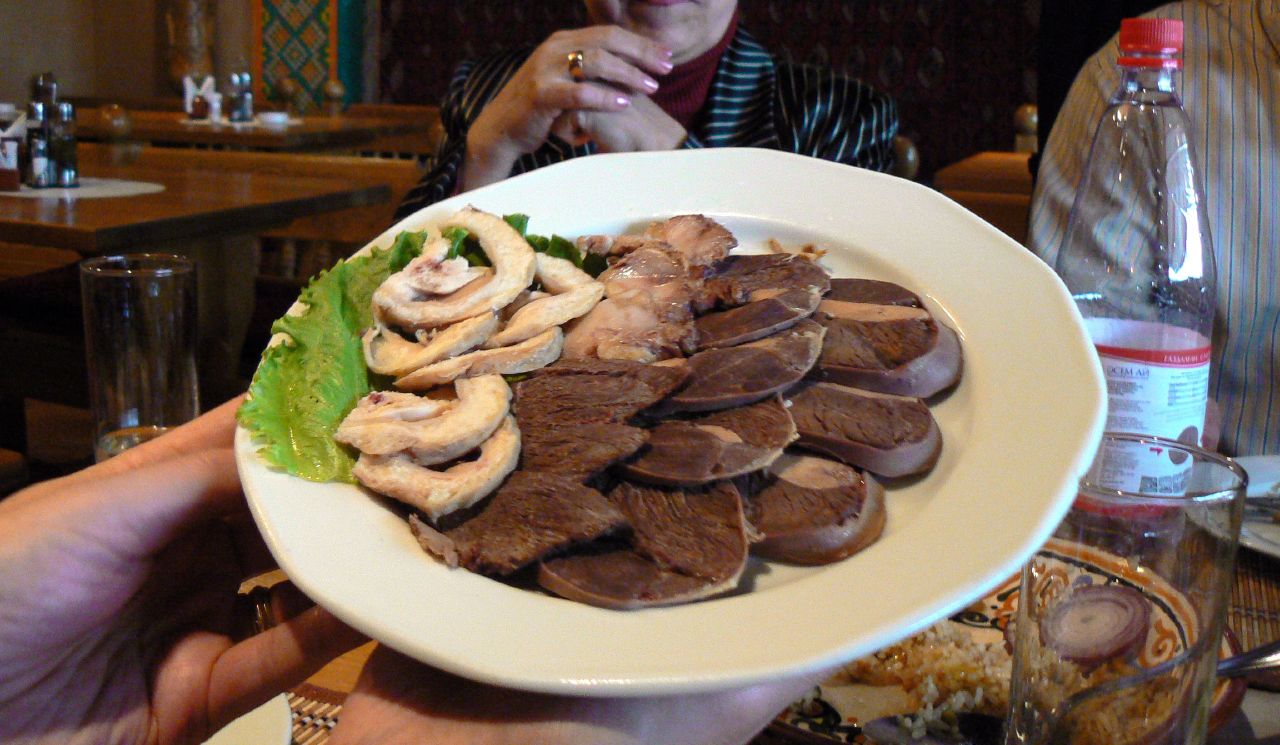
Photo: Horse delicacies include zhal (smoked lard from horse's neck) and zhaa (salted and smoked meat from horse's hip / hind leg).

Other specialty dishes include Kuiryk-bauyr  which used to be served to kinsmen at wedding parties- boiled meat, sliced thinly, then sour milk and salted broth are added. Kuyrdak (also spelled kuirdak, a dish made from roasted horse, sheep, or cow offal such as heart, liver, kidneys, and other organs, diced and served with onions and peppers) and Mypalau made by putting sheep's brain in a wooden bowl, adding the marrow and some pieces of meat, add salted fat broth and garlic.

Beverages

Kazakhs like their Karakalpaks and their Uzbeks cousins love to drink lots of Chai (tea) with their meals or with sweets after the main course.  Chai was first introduced into Central Asia from China along the silk road. Sometimes Kalmak sour cream made from boiled milk (Sut) , and is also served with tea.
 
Photo: Kumys fermented mare's milk

Traditional beverages include fermented mare (horse)'s milk (Kumys), fermented camel's milk (Chal or Shubat), cow’s milk (Ayran) are sparkling white beverages with a sour flavour and are seen as good for one’s health and are often imbibed.

Ayran (buttermilk) which is sour milk used both in winter and summer is a cold beverage of yogurt mixed with cold water and sometimes salt.

Others include Sary mai is butter made of old milk, often in a leather bag.  Suzbe and Katyk are strained and thickened sour milk and Koryktyk is a herdsman’s food- thickened milk made out on the steppe. Tosap made from the scum on the sides of a metal pot and is used as medicine.

Kurt is a type of cheese eaten throughout Central Asia which is made from dried cheese and whey and rolled into balls, prepared by pressing thick sour cream, and is dried until white and salty and Irimzhik (cottage cheese) dried sour milk product similar to Kurt, but not rolled into balls) is processed in the spring, made from boiled, unskimmed milk and added sour cream.

Source: Wikipedia and other sources. 

Wednesday, September 4, 2013

The Girjek or Spike Fiddle of Karakalpakstan


The Girjek or spike fiddle is used by Uyghurs, Uzbeks, Tajiks, Turkmens and Karakalpaks.

It is a very distinct instrument with beautful inlayed or leather covered bases it has characteristics similiar to the violin. A round-bodied spike fiddle with 3 or 4 metal strings and a short fretless a spherical resonator with a skin soundtable. Although not visible, the acoustics produced are made possible by this skin inlay soundtable within the base. The bow is made of horsehair.

The instrument is held on the knee while playing. During the 19th century the Ghirjak had two, three, four or seven strings, but by the end of the 20th century only the four-string Ghidjak was in use in Uzbekistan. The sound became stronger and diapason became wider. Other related instruments are the Girjek-alt and Girjek-prima.

In Karakalpakstan the Girjek player is called a Girjeksh. It is played both as a solo instrument and in the orchestra and is also used to accompany singers.

The origins of the girjek are not known, but the instrument is mentioned in 10th-century manuscripts which indicate that almond shells were used to construct the bridge (harak). It was depicted in 15th-century Persian miniature paintings is similar in construction to the 20th-century instrument but had a longer spike.


Source: http://nukus36.karakalpak.ru/cyberfair/girjek.html

Music Instruments of Uzbekistan The rich variety of musical instruments within Uzbekistan reflects the great diversity of musical styles performed on them. Small ensembles of mixed instruments are at the heart of the classical maqâm tradition. Characteristic instruments in such ensembles include the long-necked fretted lutes (tanbur, dutar, ud, tar, rubab, sat (setar), spike fiddle (ghijak/girjek) and the Kobooz), also present are instruments such as the side-blown flute (nai and ghadjir nai), struck zither (chang), frame drum (dayra) and a small clarinet like instrument made from reed (qoshnay). Another typical ensemble consists of long trumpets (karnai), loud oboes (surnai) and, membrane percussion instruments – (doira, chindaul and others). The kettledrums (naghora) are also an obligatory presence at festive and ceremonial occasions. In rural regions, epic singers accompany themselves on a short fretless lute (dombra), while amateur musicians play the Jew's harp (chang-kobuz) or a simple variety of the spike fiddle (kiak). Source: http://www.iberiasiatour.com/english/Music.html

Tuesday, September 3, 2013

KARAKALPAK EPIC HERITAGE - NEW CD

Karakalpak epic heritage CD

This CD is dedicated to the living musical heritage of the Karakalpak bards. It is the fruit of a fieldwork inventory conducted in 2010 by Frederic Leotar under the auspices of UNESCO,* in cooperation with cultural institutions from Uzbekistan and Karakalpakstan. This inventory, which was conducted across Karakalpakstan, resulted in the recording of nearly 300 vocal and instrumental works.

The 22 songs on this CD were selected with the help of several well-known musicians, including Qarimbay Tinibaev, the famous baqsi, girdjek player and professor at the College of Arts in Nukus, the capital of Karakalpakstan.

1. Nama basi, G’. O’temuratov, duwtar, trad.
2. Asirim, B. Sirimbetov, voice and qobiz, trad.
3. Ga’lga’lay, O. O’tambetov, voice and duwtar (N. Nuratdinov, girdjek), trad.
4. Saltiq, G. Xamitova, voice and duwtar (I. Sabourova, girdjek), trad.
5. Begler, B. O’tepbergenov, voice and duwtar, trad.
6. Ulli ziban, J. Piyazov, voice and qobiz, trad.
7. Qoshim palwan, B. Asqarova, voice and duwtar (I. Sabourova, girdjek), trad.
8. Ken’esli ton, M. Aekeev, voice and duwtar, trad.
9. Kelte nalish, Z. Ibragimova, voice and duwtar, trad.
10. Idiris, N. Nuratdinov, voice and duwtar (G. Sultamuratov, girdjek), trad.
11. Qa’wender, M. Jumatova, voice and duwtar, trad.
12. Tolg’aw, B. Esemuratov, voice and qobiz, trad.
13. Neshe gu’ller, G. Ra’metova, voice and duwtar
14. Besperde, T. Qalliev, voice and duwtar (S. Qayipnazarov, girdjek, A. Atarbaev, balaman), trad.
15. Sa’rbinaz, G. Allambergenova, voice and duwtar (I. Sabourova, girdjek), trad.
16. Adin’nan, A. Seyilxanov, voice and duwtar, trad.
17. Sanali keldi, Z. Sheripova, voice and duwtar, trad.
18. Qu’nxoja, T. Qalliev, voice and duwtar, trad.
19. Muwsa sen yari, N. Nuratdinov, voice and duwtar (G. Sultamuratov, girdjek), trad.
20. Qa’nigu’l, G. Allambergenova, voice and duwtar (I. Sabourova, girdjek), trad.
21. Nalish, M. Jumatova, voice and duwtar, trad.
22. Aq ishik, G’. O’temuratov, duwtar, trad.

Source: See UNESCO site for more information http://www.unesco.org/new/en/tashkent/about-this-office/single-view/news/karakalpak_epic_heritage/#.UicAD-3PuP8

See promo video - Karakalpak Epic Heritage (1CD -2012) http://www.videomix.cz/video/V156UOa-8to/
 

Saturday, May 25, 2013

TOURISM IN UZBEKISTAN

Uzbekistan Tourist Destination

Every year the number of tourists visiting Uzbekistan increases. Interest in its unique culture and heritage, in particular its historical and architectural monuments which are by far the most striking in Central Asia, grows steadily.

Uzbekistan situated on the cross roads of the Silk Road boasts more than 4,000 historical and architectural monuments. Besides a plethora of archaeological sites it also offers incredibly beautiful mosques, mausoleums, palaces, forts, ruined temples and monasteries and shrines; an invaluable spiritual heritage of its long and great history that is preserved with care. The main tourist centers of Uzbekistan ― Samarkand, Bukhara, Khiva, and Shakhrisabz are included in the UNESCO World Heritage List ― attract millions of foreign tourists annually.

Whilst tourism in Uzbekistan has been primarily centered on its rich cultural heritage. The country is also blessed with many varied and contrasting landscapes; natural beauties such as  mountains, valleys, desserts, forests and rivers.  There are also many adventure activities available for visitors including trekking, mountain climbing, water sports, river rafting,hot springs, safaris, bird watching, fishing, horse back riding and skiing. In addition Uzbekistan is famous for its rich traditions of hospitality, which are so deeply rooted within its people. This coupled with an amazingly varied and tasty cuisine all make it a very attractive and interesting tourism destination for travelers from all over the world.

Useful links:
Ministry of Foreign Affairs of the Republic of Uzbekistan

National Company "Uzbektourism"

Karakalpakstan Tourism


Karakalpakstan at 165,700 km2 is the largest region of Uzbekistan, accounting for over a third of its entire land area (447,400 km2). In the northwest, it includes a large part of the Ustyurt plateau that lays between the Caspian Sea and the erstwhile Aral Sea; to the east is the Kyzyl-Kum desert, which reaches further into Uzbekistan and Kazakhstan.

The fertile part of the region is the Amu Darya river delta - formerly ancient Khorezm, which is today shared by three distinct entities: the Uzbek oblast of Khorezm, whose capital is Urgench; the Turkmen oblast of Dachaouz; and the autonomous republic of Karakalpakstan, whose capital is Nukus.

Karakalpakstan has a long and rich history with diverse cultural offerings ranging from, at one extreme, the ruins of Khorezm’s ancient (5th century BC) civilization to, at the other, the Nukus Museum, which houses the Savitsky Collection comprising the world’s second largest collection of 20th century Russian avant garde art as well as the largest folk art collection in Central Asia.

The Republic is also the site of a major environmental catastrophe: the disappearing Aral Sea, formerly one of the world’s fourth largest inland lake and now reduced to only a small portion of its original size. Visting the former coastal town Muynak is  a very moving experience.

Karakalpakstan’s climate is extreme continental, i.e. very cold in winter and very hot in summer, so the best time to visit is either in the spring or early summer (April through June) or in the fall/Autum (September through mid-November), when temperatures range between 15-25C.

Karakalpakstan is not a conventional tourist destination, nor for the faint-hearted. But, as increasing numbers of International travelers prove, it offers many unique artistic, cultural, historical, and environmental attractions and perspectives.

LINKS For more information about tourism in Karakalpakstan see the following sites:


Friday, May 24, 2013

The beginning of construction of the second stage of the State Art Museum of the Republic of Karakalpakstan named after I.V. Savitsky.


The beginning of construction of the second stage of the State Art Museum of the Republic of Karakalpakstan named after I.V. Savitsky is underway and is expected to take 4 years.  The second stage of the Savitsky Art Museum will include additional exhibition and storage space to house the large collection of items held by the museum.

Construction of the facility started on the 10 march 2013 and is being undertaken by ."Uy-Zhay Kurylys." on behalf of the  Council of Ministers of the Republic of Karakalpakstan.

Founded in 1966, the Savitsky Collection is located in Nukus, Uzbekistan and holds over 90,000 items of art (paintings, graphics, sculptures, folk and applied art and archaeology). Considered to be the second largest Russian Avant-Garde art collection after the Russian Museum in St. Petersburg.

Igor Savitsky, a Russian born in Ukraine, moved to Central Asia in the 1940s to work as an artist on the Khorezm archaeological expedition. He stayed, collecting Folk and Applied Art of Karakalpakstan, and moved into other areas of collecting, notably Russian and Uzbek Avant-Garde of the 1920s.

The Savitsky Collection has one of most impressive and moving stories of any museum in the world to find out more go to www.savitskycollection.org

Friday, March 29, 2013

Karakalpakstan to boost silk production

The Uzbek Cotton Industry Association (Uzpakhtasanoat) is currently initiating a project to further develop the sericulture industry in the Republic of Karakalpakstan. The cost of the project is estimated at 7.744 billion soums (approx 4 million USD).

 All five existing processing plants are to participate in the project which aims to construct additional production facilities and increase the on farm production of silk cocoons by developing an additional 60 hectares of mulberry plantations.

Source: See more at: http://www.uzdaily.com/articles-id-22319.htm#sthash.kRgvGCdR.dpuf