Thursday, September 18, 2014

Uzbekistan Airways Flights to Nukus from Tashkent (Summer)


SUMMER 2014 FLIGHT SCHEDULE

Timetable for flights from Tashkent, Uzbekistan (TAS) to Nukus, Uzbekistan (NCU)
FlightOperational daysDeparting TashkentArriving NukusDurationAircraft
HY1003Monday06:0507:501:45320
HY1001Tuesday, Wednesday, Thursday, Friday, Saturday, Sunday07:1009:552:45I14
HY1005Monday, Sunday12:3015:152:45I14
HY1007Tuesday, Wednesday, Friday17:3019:151:45320
HY1007Sunday17:3020:152:45I14
HY1009Sunday17:4020:252:45I14
HY1007Thursday19:0020:451:45320

Timetable for flights from Nukus, Uzbekistan (NCU) to Tashkent, Uzbekistan (TAS)

FlightOperational daysDeparting NukusArriving TashkentDurationAircraft
HY1002Tuesday, Wednesday, Thursday, Friday, Saturday, Sunday10:3512:502:15I14
HY1006Monday, Sunday15:5518:102:15I14
HY1004Monday18:2019:451:25320
HY1008Tuesday, Wednesday, Friday19:5521:201:25320
HY1008Sunday20:5523:102:15I14
HY1010Sunday21:0523:202:15I14
HY1008Thursday21:2522:501:25320

Summer Schedule: 31 March 2014 - 31 October 2014

Source: Advantour http://www.advantour.com/uzbekistan/uzbekistan_airways/tashkent-nukus.htm

La Forteresse d'Ayaz-kala


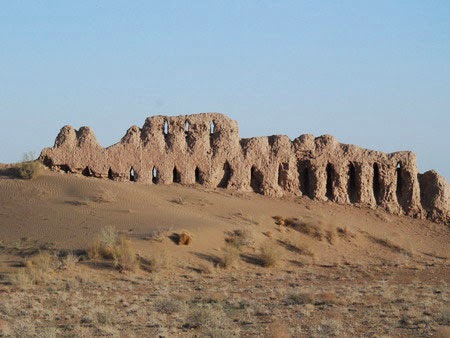
Forteresses d'Ayaz Kala 1 et 2 dans la république du Karakalpakstan et le désert de Kyzyl Kum en Ouzbekistan. Ayaz Kala 1 en haut est la plus ancienne (3e s. av. J.-C.). Ayaz Kala 2 est en dessous.


Video : Vue à partir de la forteresse de Ayaz Kala 1. French 1:12 


Thursday, September 11, 2014

A SELECTION OF UZBEK CUSINE


Lagman Soup         


1. Lagman - This is a spicy, meaty broth filled with chunks of lamb, handspun noodles, and vegetables.
 
 
Chuchvara Soup


2. Chachvara - A soup in which small dumplings are boiled in salt water or bouillon and served with sour milk (“suzma”) and seasoned with pepper, onion, tomato paste, black pepper, and sour cream. Known also as Pelmeni a favourite throughout Central Asia and the CIS.
Wedding Pilaf (Plov)


3. Plov - The national dish Plov is a mixture of rice, chunks of meat, grated carrots and onions, and sometimes raisins (with cloves of roasted garlic). Traditionally cooked in a Kazan over an open fire. Can be used to feed large numbers of people popular at Weddings and other festivities. 


Manty


4.  Manty - Steamed dumplings sprinkled with dill and served with sour cream. Meat, spices, or vegetables can be used as a filling.


5. Samsa - A triangular dough pastry that’s baked in a tandoor oven so that the bread is somehow both crunchy and super-soft. Can be filled with a variety of things, including ground lamb, herbs, or pumpkin.
 
 
Achichuk Salad 


6. Salat Achichuk - This dish made up of thinly sliced tomatoes and onions seasoned with spices.


Naryn


7. Naryn - The dish is composed of hand-spun noodles and boiled jerk meat, served with minced onions and black pepper. Traditionally, it is made with horse-meat.


Shurpa

8. Shurpa - A soup made out of fatty meat (usually mutton) and fresh garden vegetables like tomato, carrot, and slices onions. There are two versions: Kaytnama (made from fresh meat) and Kovurma (made from fried meat).


Dimlama


9. Dimlama - A hearty stew made of meat, potatoes, onions, vegetables and sometimes fruit and  is always sprinkled with dill.


Kutabi


10. Kutabi - Flatbread, and these are deep-fried and served with either meat or vegetables inside.


Kebab (Shaslik)
11. Shaslik - Chunks of lamb, chicken, or lyulya (a mix of mutton and spices) served on steel skewers and topped with more slices of raw onion than you ever thought you’d encounter. It’s often served with Adjika- a bright red, spicy sauce made from hot red peppers.


Tea and Sweets


12. Tea and Sweets- Uzbek tea comes in a wide assortment of green, black, and herbal varieties, and is served with Sweets or nuts.


Monday, September 8, 2014

Abandoned Fortresses in the Kyzylkum Desert of Uzbekistan

Good amateur Video 4:47

Music: Feast of Khans by Vyacheslav Ismagilov and main theme of Yuri Khanin's soundtrack to Days of Eclipse

Go to http://vimeo.com/52366328\


Gyaur Kala

Gyaur-Kala is dated back to IV-XIIIth centuries BC. Excavations are still being carried out until today. The cultural layer of this city, according to archeologists, reaches 10 meters. The contours of the ruins indicates about the massive fortress and religious temples that once were located there. Their findings suggest that Guyar-Kala was a busy trade and handicraft center.
 
Gyaur Kala (or Qala) meaning infidel fortress was a name given by the Arab conquerors of the Khwarezmian empire. There are actually three Gyaur Kalas in the region, one not to far away across the river and south beside the Sultan Uvays hills and the other in Turkmenistan's Marv area in the old Avestan country of Mouru.

The fortress appears to have been constructed and occupied by the 4th century BC during the height of the Persian Achaemenian empire. It also appears to have been destroyed by fire towards the end of the 2nd c. BC and then rebuilt and in use from the 1st to the 4th century AD until it was destroyed yet again.

Monday, September 1, 2014

Djanbas Qala Fortress

Djanbas Qala, Fortress, 4th c. BC - 1st c. AD

Djanbas Qala is located about 47km north east of To'rtku'l on a barren upland which closes a chain of hills stretching south-east from the Sultanuizdag range and is one of the oldest fortresses in the Republic. It was first excavated by the Khorezm Archaeological Expedition led by Sergey Tolstov in 1938.  The fortress was built in the 4th century BC to protect nearby agricultural settlements and is believed to have been destroyed by nomadic tribes who managed to break through the fort's defences sometime during the 1st Century AD. Materials collected on the site, mostly ceramics, are inherent to the early antique (Kangyuy) culture of Khwarezm.
 
The extant walls make a rectangle of 3.5 hectares in area each and are oriented towards the east, west, north and south. Covered with sand dunes in some places, these double, five-metre-thick walls reach up to 20 metres in height. Between the outer and inner walls of the fortress there is a 3-meter-wide passageway. The lower part of the walls, up to the level of the embrasures, is made from wattle and daub with streaks of brickwork; above the walls are made of adobe bricks. The only entrance to the fortress on the northwest side,

Djanbas-Kala is as such quite distinct from most other Central Asian fortresses as it has neither corner nor in-wall turrets but still provided a strong defence. Fortifications without turrets belong to  a very distant past, they are found neither in antique Mediterranean civilizations nor in the ancient Orient. Another interesting feature characteristic of Khwarazm traditions is the narrow corridor connecting the gate facilities so that the defenders could fire at the enemy from the battlements. Around the whole periphery the outer walls of the fortress there are two staggered rows of arrow-shaped embrasures. Between the rows, from inside, there were built wide ledges for the defenders to stand on. The narrow 20-centimeter-wide embrasures were specially designed to shoot arrows downwards towards the foot of walls and steep slopes facing outside. To better able defenders to repulse of the enemy on the flanks, the walls of the fortress were provided with a group of three specially arranged embrasures: the central one directed straight ahead at a right angle, and two side ones directed right and left respectively at an obtuse angle. Each group of embrasures (with apertures opening inwards) being arranged with a small arched niche provided with a space for one archer. Such systems in the walls alternated with a set of 20-30 ordinary embrasures. The corners of the walls also had pairs of embrasures looking sideways.

Excavations at Djanbas Qala have uncovered a large number of ceramic fragments, terracotta statuettes and various artefact's. Among them were bracelets, signet-rings, jade and crystalline pyrite beads, and, notably, a large number of glass beads of various shapes and colours. Such glass beads were wide-spread in the northern Black Sea area, which provides proof of well-established trade routes.

However, among the hundreds of artefacts there was not a single coin to be found, which proves that the town had existed in the 1st century the latest, as in Khorezm the first coins came into being only at the beginning of the 2nd century, in the times of the Great Kushans and Khorezmshakhs. he inhabitants were most likely farmers working in the fields outside the town. One of the excavations brought to light the remains of a tandur clay oven, whereas in other rooms of the dwelling there were discovered grain graters typical of Kanguy period.

The inhabitants worshiped Zoroastrianism, one of the world's oldest religions that spread for more than a thousand years over a huge area between Khorezm and India, and Xinjiang and the Middle East. Most scholars believe that it was Ancient Khorezm where Zoroastrianism originally appeared. It is impossible to establish either the exact date the religion originated, or the date of birth of its prophet Zaratustra (Zoroastr in Greek). Scholars only suppose that he lived sometime in the 7th – 6th centuries B.C.

The ruins of the temple of fire and the sun are located on a mound 4.5m high across from the main gate. The temple was the centre of the town's spiritual life. There can still be seen the remains of the oval pedestal that made up the altar, on which the holy fire used to burn day and night, as was required by the Zoroastrian religious rituals. Along the wall there is also a partly-ruined long stone bench for the priests who were to keep the eternal fire by feeding it with fruit tree twigs. It was the place where they performed the fire purification ceremony and sang Avesta hymns. The temple had also a large room where, judging by a great number of fragments of earthenware and animal bones inside it, the Zoroastrian dining ritual Boj Giriftan would take place.

Burials occurred outside of the city, where the dead were placed on the flat tops of Dakhma's "towers of silence" or in specific locations in the surrounding hills for vultures and animals to feed on. Then the bones of the dead would then be put in special ossuary containers. On the outskirts of Djanbas–Kala in the 1960s archaeologists discovered a large collection of such containers. Made of baked clay and covered with glaze they date back to the 1st century B.C. Most likely, the place these ossuary's were found in, was a kind of necropolis of Djanbas Qala. The containers were of various sculptural forms: a woman sitting on a throne or a horse-rider or in the form of a fortresses with arrow-shaped "chessboard order" embrasures, cornices and pilasters.
 
For five centuries Djanbas Qala residents had to repeatedly defend their town from hostile nomads. In the 1st century BC during one of these attacks invaders managed to break open the wall south of the main fortified gate by force using a ram, and burst inside. The enormous number of metallic arrow-heads of two types, found inside the town, testifies to a fierce fight that took place. Most defenders were probably killed, with those who were spared taken as slaves; the fire temple and dwellings were all destroyed. 

Over time the appearance of the Qala has slowly changed under the influence of water and wind and parts of the walls are almost covered by sand but much of the original structure whilst eroded is still intact.

Wednesday, August 27, 2014

Джанпык Кала

Джанпык-Кала крепость Djanpyk Kala Video (Russian) 4:39


•Джанпык-Кала. Городище IX-XI вв., XIII-XIV вв. н.э.


Городище расположено в 6 км юго-восточнее поселка Каратау, на юго-западных отрогах Султануиздагского хребта. Один из живописнейших памятников правобережной части Амударьи.

Городище в плане имеет сложную конфигурацию. В восточной части сохранилась цитадель в виде прямоугольника пахсовых стен. Стены украшены сомкнутыми полуколоннами и вершины кончаются попарно ступенчатыми арочками.

Археологические раскопки позволили уточнить хронологию городища. Древнейшая керамика относится к IV в. до н.э. - I в. н.э. Дата последнего обживания определяется монетами 1319-1320 гг. и 1345-1346 гг.

При раскопках обнаружены многочисленные находки ранее привезенные из различных стран Востока и Запада. (Китая, Египта, России, Европы, Индии). Городище служило портовым городом в средневековье.На окраине Джанпык-калы можно увидеть бескрайние просторы заповедника Бадай Тугай.