Showing posts with label chorasmia. Show all posts

Tuesday, February 17, 2015

Los Afrighids

Los Afrighids

obversereverse

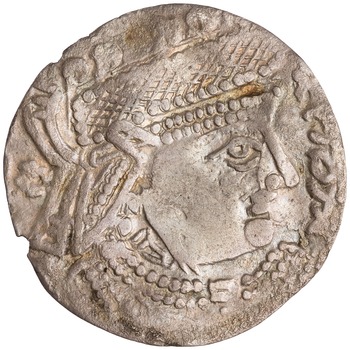
Foto: Khwarizmian, Abd Allah Shah - El Jinete AD 773-797

Durante todo el período de la antigüedad local (siglo 1 aC - principios de siglo 3 dC) en Khorezm, los reyes Afrigid subió al poder, a juzgar por su símbolo dinástico jinete - a - su continuidad en el gobierno de 700-800 años. Los Afrighids (آفریغیان-آل آفریغ) eran un natural Chorasmian (Lengua de Khwarezmian) dinastía que gobernó sobre el reino de Khwarezm de 305 hasta 995 d.J.C. El reino renaciente fue establecido alrededor de Khiva en 410 por Avar (El euroasiático Avars) tribus posiblemente bajo Hephthalites influencia.

En 712 Khwarezm fue conquistado por el árabe Umayyads. Así vino vagamente bajo el señorío feudal musulmán, pero sólo en el final del de ocho siglos o el principio del 9no siglo que Afrighid Shah se convirtió primero al Islam aparición con el nombre del converso popular de Abdallah (esclavo de Dios). En el curso del 10mo siglo, cuando algunos geógrafos como Istakhri en su Al-Masalik wa-l-mamalik mencionan Khwarezm como la parte de Khorasan (Mayor Khorasan) y Transoxiania, la familia local de Ma'munids quienes estaban basados en Gurganj (Köneürgenç), en la orilla izquierda de Amu Darya creció en la importancia económica y política debida de cambiar caravanas. En 995, violentamente derrocaron Afrighids de Kath y ellos asumió el título tradicional del Khwarazm-cha. 

Brevemente, el área estaba bajo Samanid señorío feudal, antes de que pasara a Mahmud of Ghazna en 1017. A partir de entonces, las invasiones Turco-mongolas y la regla larga de dinastías Turco-mongolas suplantaron el iraní carácter de la región aunque el título del Khwarezm-cha se mantuviera bien hasta el 13er siglo.

Foto: Tazón de plata que representa a una diosa de cuatro brazos, sentada sobre un León, fechado 658 D.C.de Khwarezm , Museo Británico.


Friday, June 10, 2011

The Afrighids

The Afrighids (pre-Islamic times to 995 AD)  were a native Chorasmian dynasty who ruled over the ancient kingdom of Chorasmia from early in the 4th century AD. up until the end of the 10th century AD. They stayed in control after the Arab conquest of 712 AD and the subsequent period of Islamic conversion.


Silver drachm of Sawrshafan (Ca. 751-762 AD)


The kingdom was established by Avar (Hun) tribes possibly under Hephthalites influence. By the 4th Century AD  there was already large-scale agricultural exploitation of the lands lying along the banks of the Oxus river and in the Aral Sea delta with large estates fortified against incursions from the steppe and an extensive and complex system of irrigation canals (see S. P. Tolstov, Auf den Spuren der altchoresmischen Kultur, Berlin, 1953, pp. 207ff.)


Little is known about the first four centuries or so of the Afrighids’ rule. The first King, Afrig is said to have built the great fortress of Fil beside the Choresmian capital Kāt, 40km south of Toprak Kala (today near the site of the modern town of Beruni). It was undermined and swept away by changes in the flow of the Oxus (Amu Darya) in the 10th century AD nd only the vestiges of it could be seen in AD 994 when the great scientist and historical scholar Abu Rayhan Biruni a native of Kwarezm wrote in his book The Chronology Of Ancient Nations; which is the first definitive historical source on the Afrighids prior to Islam.

Bivasar, ca. 300-350 (Afrighid / Chorasmia)

Reduced Tetradrachm of King Brawik early 7th Century (Afrighid Dynasty)


Abu Rayhan Biruni mentions twenty-two rulers of the Afrighid dynasty who  ruled, mainly, in the pre-Islamic period .in total a span of 690 years. Whilst unlikely to be a complete list as on average each ruler would have had 31 years it is a chronicle of the most important rulers. According to Biruni the Afrighids ruled from 305 AD, through the Arab conquests under Qotayba b. Moslem in 93/712, up until their overthrow in 385/995 by the Ma'munids.


His list of the Afrighid kings of Khorezm in chronological order (see notes below for the list in the Chorasmian  language) :


01. AFRIG (ATHRIKH) 305 – 320

02. BAGRA (BUGRA) IBN AFRIG 320 – 340

03. SAKHKHASAK (ZAKASSAK) IBN BAGRA

04. AZKADJAMUK I (ASUKDJAMUK) IBN SAKHKHASAK

05. AZKADJAVAR I (ASUKDJAVAR) IBN AZKADJAMUK I 415 – 445

06. SAKHR I IBN AZKADJAVAR I

07. SHAUSH IBN SAKHR I

08. KHAMGARI (HUMKAR) IBN SHAUSH

09. BUZGAR (BUZKHAR) IBN KHAMGARI

10. ARSAMUKH (ARTHAMUKH) IBN BUZGAR contemporary of Prophet Muhammad

11. SAKHR II

12. SABRI

13. AZKADJAVAR II (ASUKDJAVAR) 710 – 712 opposed by KHURRAZAD 710 – 712

14. AZKADJAMUK II (ASUKDJAMUK) IBN AZKADJAVAR II

15. SAVSHAN

16. TURKASABATHA

17. AZKADJAVAR III (ASUKDJAVAR) – ‘ABDALLAH IBN TURKASABATHA

18. MANSUR IBN ‘ABDALLAH

19. IRAQ IBN MANSUR 898 – 921

20. MUHAMMAD IBN IRAQ 921 – 944

21. ‘ABDALLAH IBN ASHKAM 944 – 967

22. ABU SA’ID AHMAD IBN MUHAMMAD 967 – 995

23. ABU ‘ABDALLAH MUHAMMAD IBN AHMAD 995


Abu Rayhan Biruni states in the The Chronology Of Ancient Nations states that he believed that the main reason for this gap in information was that “ When Qutaibah bin Moslem under the command of Al-Hajjaj ibn Yūsuf was sent to Khwarazmia with a military expedition and conquered it for the second time, he swiftly killed whoever wrote in the Khwarazmian native language and knew of the Khwarazmian heritage, history, and culture. He then killed all their Zoroastrian priests and burned and wasted their books, until gradually the illiterate only remained, who knew nothing of writing, and hence the regions history was mostly forgotten.” (ED: sadly like most religious zealots the Arabs of the day much preferred ignorance to enlightenment)  


It has been suggested that the term 'Afrigh' is the Arabicized of 'Abriz' in Persian which translates as "where water flows" , a reference to the geography of Khwarazm and its abundant waters.


Ancient Khwarazm


Being well irrigated the rich agricultural region of the lower Oxus (Khwarazm) developed in isolation from other regions. Surrounded by all sides by steppe land and desert the delta was geographically isolated from other areas of civilization. This isolation allowed it to maintain its separate distinctive proto-Iranian language and culture up until the waves of Turkic- migrations in the 8th -10th centuries.   By the 10th century many parts of Central Asia had been settled by Turkic tribes.


Before the  8th century AD there had only been sporadic and ineffectual Arab raids on the fringes of Ḵhorezm from the directions of Khorasan and Transoxania. But in A.D 712 the Arab governor of Khorasan, Qotayba b. Moslem Baheli was able to intervene in internal Khwarazmian politics when the Afrighid shah was embroiled with his brother Khorrazad in a civil war. Once Khwarezm was conquered by the Arab Umayyads it came vaguely under Muslim suzerainty, but it was not until the end of the eight century or the beginning of the 9th century that an Afrighid Shah was first converted to Islam appearing with the popular convert’s name of ʿAbdallah (slave of God).


The Arab invasions lead to much destruction as Biruni notes. However once the Arabs withdrew, the Shahs recovered power in Chorasmia and in time the stipulated tribute lapsed, and the population reverted to their ancestral faith Zoroastrianism. The Shahs continued to join with the princes and merchants of Soghd in resisting the Arabs, seeking to call in help from their Turkic neighbors’.
But again by the early 10th century, the Samanids once again had brought Khorezm into tributary status.


Ibn Fadlan who was sent by the Abbasid Caliph of Baghdad as an ambassador to the Kings of the Bulgars in AD 921, went first to Bukhara to pay his respect to the Amir before proceeding to Khoresm and crossing through the Ustsurt Desert to the Volga (A. Z. V. Togan, Ibn Fadlāns Reisebericht, AKM 24/3, Leipzig, 1939, sec. 4). He visited Khoresm during the reign of Shah Mohammad b.Erāq. (His nephew, Abū Nasr Mansūr b. Alī b. Erāq, was to be Bīrūnī’s teacher and a celebrated scholar of Ḵhoresm at the time of the Maʾmunids.) Shah Mohammad acknowledged to Ibn Fadlan the superior rights of al-Amīr al-Aǰall, the Samanid ruler (Togan, op. cit., secs. 4-14). In fact, the Shahs seem to have been little disturbed in Khorezm, except when they were injudicious enough to shelter Samanid rebels. As Samanid authority weakened towards the end of the 10th century AD, the Shahs were able to extend their authority across the Qara Qom Desert and over the frontier towns and outposts of northern Khorasan.


In AD 995 the Afrighids of Kath were violently overthrown by their neighbors the Turkic Ma'munids from Gurganj. The end of the Afrighids came suddenly, and as the result of an internal convulsion and change in the balance of power within Khorezm. In the course of the tenth century, the local family of the Ma'munids who were based in Gurganj, on the left bank of the Oxus (Amu Darya) grew in economic and political importance situated as it was at the terminus of trade routes across the steppes to south Russia. So when in AD 995 the Ma’munids attacked and captured Kāt, killed the last Afrighid, Shah Abū bAbdallāh Mohammad, they themselves assumed the historic title of Khwarazm-Shah.


Briefly once again the area was under Samanid suzerainty, before it passed to Mahmud of Ghazna in 1017. From then on, Turco-Mongolian invasions and long rule by Turco-Mongol dynasties supplanted the Iranian character of the region although the title of Khwarezm-Shah was maintained well up to the 15th century.


Notes: 

Name of the rulers given by the native Chorasmian speaker Biruni.

1) ʾfrḡ, Āfrīḡ.

2) bḡrh

3) sḵḵsk

4)ʾskǰmwk

5) ʾzkʾǰwʾr

6) sḵr [I]

7) sʾwšš, Sāvoš (Syavash)

8) ḵʾmkry/ḵʾnkry

9) bwzkʾr

10) ʾrṯmwḵ, Arṯamūḵ (mentioned also in coins)

11) sḵr

12) sbry

13) ʾzkʾǰwʾr [II].

14) ʾskǰmwk [II].

15) šʾwšfr.

16) trksbʾṯh

17) ʿAbdallāh.

18) Manṣūr.

19) ʿErāq.

20) Moḥammad.

21) Aḥmad.

22) Abū ʿAbdallāh Moḥammad, killed in 995.


Silver Drachma of Azkatsvar-Abdallah. AD. 770-800. (The first Islamic Khwarazm Shar)


Only consonants of the pre-Islamic names are known with long vowels, since in Arabic script, the short vowels are not written and diacritic signs are used to clarify when required. After the conversion of 'Abdallah, all the names expect possibly 'Eraq are Arabic and their pronunciation is known. Unfortunately, the manuscripts that have also come down have also suffered some corruption due to scribal errors, since the names were incomprehensible for most non-natives. Biruni himself utilizes the extra letters of Chorasmian which were not used in Arabic writings. Much more is known about the dynasty in the Islamic era after the beginning of the 8th Century and their conversion to Islam.


Sources:

C.Clifford. E.Bosworth, The New Islamic Dynasties: A Chronological and Genealogical Manual, Columbia University, 1996.

Al-biruni. The Chronology Of Ancient Nations, trans. Eduard Sachau. London: Elibron Classics, 2005

H. A. R. Gibb, The Arab conquests in Central Asia, London, 1923

L. Massignon, "Al-Biruni et la valuer internationale de la science arabe" in Al-Biruni Commemoration Volume, (Calcutta, 1951).

E. Sachau, “Zur Geschichte und Chronologie von Khwārizm,” Sb. Wien. Ak. Wiss., Phil. Hist.

Monday, March 15, 2010

The Ancient Khoresm Fortresses of Karakalpakstan

Less than 1hr from Nukus is Mizdakhan. It is three kilometres from the former capital of Karakalpakistan - City of Khodjeyli - and 19 km west of today's capital Nukus. Once the largest city in Khorezm requires 2-3 hours in total (from Nukus); to visit including the Mazlumkhan Sulu Mausoleum and Gyaur-Kala.

Mizdakhan

Today Mizdakhan is a cemetery dating from the 4th century BC. Located on three hills about twenty kms to the west of Nukus (overlooking the once mighty Amu Darya river now reduced to a large stream), the complex provides a good overview of the burial site. It includes the Mazlumkhan-sulu mausoleum, in which visitors can descend stairs to a beautiful cupola structure with bright blue tiles.

"Maslum Khan Sulu Mausoleum"


The beautifully restored Maslum Khan Sulu is shrouded in a colourful local legend. The mausoleum the legend goes was built for a young princess Mazlim Khan, who died for her love for the prince of a rival principality. You can enter the mausoleum which has been restored to its former beauty after independence. It is serene and beautiful inside, with geometric patterns and carvings. It has been a place of local veneration for centuries.

Other day trips from Nukus

Max 2-3 hrs from Nukus or 1-2 hrs from Khiva/Urgench permits you to view some other fascinating archeological sites.

Toprak Qala, fortress of I-IV centuries A.D


Toprak Qala located near Buston was discovered by Soviet archaeologist Tolstov in 1938, is a complex covering approximately 17 hectares, surrounded by rectangular walls up to eight meters high in some places. The largest tower in the middle of the southern wall near the entrance to the Toprak Kala is over 60m high. Approximately 100 rooms are preserved, which show its complexity. Recent excavation has unearthed the palace archive, a number of glass vessels, alabaster sculpture fragments as well as some fantastic murals on the interior walls.

Gul’dursun

Gul’dursun is a fortress predating Christianity that existed until the 13th century, located approximately 20 kms to the east of Biruni. Originally discovered by the Soviet archaeologist Gulyamov in 1937, it was excavated by Tolstov and work completed by Dospanov in the late 1980s and early 1990s. The structure takes the form of a 350x250 meter rectangle, within which a number of important discoveries have been made, including antique and medieval coins, Middle Age ceramics, and bronze articles.

Ayaz-kala


One of the most spectacular archaeological sites in Khorezm, Ayaz-kala comprises the remains of three fortresses constructed during the 5th-4th centuries BC that are clustered together on and around a prominent hill, with magnificent views of the surrounding countryside. Nearby, a gravel road from the main Urgench-Nukus highway leads to a small cluster of yurts, a tourist rest and recreation center overlooking a shallow but picturesque lake. Chil’pyk. A circular, high-walled enclosure on an isolated peak overlooking the Amu Darya river,

Chil’pyk

A religious building of II-IV, IX-XI centuries A.D. Originally a Zoroastrian dakhma and later used by local people as a beacon. A dakhma or tower of silence was used by people of the Zoroastrian faith for exposure of the dead. Bodies were laid out under the open sky and, after the bones were cleaned, families collected them and placed them in clay or stone ossuraries for burial. Chil’pyk can be seen clearly and is easily accessible from the main road about 40 kms south of Nukus.

Other recommended places to visit -

Badai-Tugai Reserve

The Tugai forests are the original vegetation of the river banks and their preservation is critical for the ecological and environmental well-being of the entire region. On the road southwards from Nukus to Beruni, a 6,500 hectare park has been established to protect one of the last relatively pristine stretches of Tugai forest along the eastern bank of the Amu Darya river. The reserve is a sanctuary for a variety of birds and small mammals as well as a herd of endangered Bukhara deer.

Moynaq


Another day trip north from Nukus (6-7 hrs is needed) is a visit to the old Aral Sea Port at Moynaq, including its museum and the ship cemetery (210 km north of Nukus) - as late as the 1960s, Moynaq was a significant fishing port and seaside resort on the Aral Sea, but is now more than 150 kilometres from its receding shore.


Suggested Basic Itineraries
From Nukus:

* Half-day visit to Mizdakh-khan―about 2 hours driving and one hour at the site.
* Full-day visit to Chil’pyk, Toprak-kala, Bustan and Ayaz-kala―about 4-5 hours driving and three hours visiting all the sites.
* Full day visit to Moynaq―about 6 hours driving and two hours at Moynaq.

From Urgench:

* Full-day visit to Toprak-kala, Badai-Tugai Reserve, Chil’pyk and the Savitsky Collection in Nukus about 4-5 hours driving and one-one and a half hours at each location (30 minutes at Chil’pyk)
Sunday, June 14, 2009

The Karakalpak-Australian Excavations in Ancient Chorasmia


Photo - The head of a king, from the newly uncovered mural atKazakl'i-yatkan
The traditional fascination visitors have in visiting Uzbekistan lies in the ancient oasis towns along the Great Silk Roads. The blue tiled medressehs, minarets and mausolea of Samarkand, Bukhara and Khiva are among the most spectacular medieval monuments in the world, and stand testimony to the culture and civilisation of this ancient land. Yet beyond theses monuments are even older cities, citadels whose walls were standing in the time of Alexander the Great, as his armies passed by on their way to India.These cities, long lost under the desert sands, were first investigated by Soviet Archeological & Ethnographic Expeditions to Khoresm led by Sergei Tolstov starting in the 1930s. The expeditions found hundred of ancient sites, many with massive fortifications still standing preserved almost intact in the dry desert air.

The best of these sites lie in Karakalpakstan and Khorezm (ancient Chorasmia) at the western end of Uzbekistan, where the Amu-Dariya river spreads out into a delta before draining into the Aral Sea. Today, the land here is a patchwork of cotton and rice fields and pasture by the ever encroaching desert. The canals that sustain the oasis today were constructed during the Soviet era but the first irrigation channels were cut in about the 7th century B.C. to support newly established kingdoms in the region. A team of University of Sydney archaeologists and specialists from the Karakalpak Branch of the Uzbek Academy of Sciences have found magnificent ancient paintings in a monumental building (temple), within the massive fortified settlement of Kazakl'i-yatkan in the east of Karakalpakstan.The site they are excavating dates from the 6th century BC to the 2nd century AD. Kazakl'i-yatkan became independent around the 5th century BC and grew increasingly isolated, but during this period it developed a rich indigenous civilisation.

The region was never conquered by Alexander and remained cut off from almost all outside influence until around the 1st century AD.On the evidence they have unconvered so far, these murals may have covered more than a kilometre of wall. They show amazing scenes including a long procession of a desert caravan with men on and aside pack horses and camels and also a gallery of magnificent portrait heads, possibly depicting members of the ruling families. Some of these paintings are being lifted from the ground and walls before being restored with additional help from UNESCO specialists on loan from the French Government and transferred to state museums and eventually for international exibition.


From about the 7th/6th centuries BC ancient Chorasmia was located south of the Aral Sea, in the delta of the Classical Oxus River (mod. Amu-dar'ya). To the north lay the Inner Asian steppe (now Kazakhstan), to the west the cliffs of the inhospitable Ustiurt Plateau (further west, the Caspian Sea), to the east the delta of the Classical Jaxartes (mod. S'ir-dar'ya), and to the south two deserts, the Kara-kum and Kz'il-kum which separated Chorasmia from Margiana and Sogdiana. Its geographical isolation form the "civilsed" ancient Indo-Iranian world resulted in virtually independent cultural development for much of its early history and, later on, after the devastation caused by the Mongols and particularly Timur, remarkable preservation of pre-Islamic monuments the like of which cannot be found anywhere else in Central Asia. Long before archaeological explorations began, Chorasmia was known from Persian and Greek texts as a province (satrapy) of the Achaemenid Persian empire; it also stands as the possible area of the "Aryan Expanse" of the Avesta, as the best land created by Ahura Mazda and therefore of signal importance regarding the early stages of the Zoroastrian faith. By the time of Alexander the Great Chorasmia was independent and had a king. This is the last textual mention of Chorasmia until the early medieval period, although it may have had relations with the Kushan empire at least from the 2nd century AD onward. Exploration began in the I930s under the leadership of S. P. Tolstov who founded the Chorasmian Archaeological Expedition whose work continued up to the collapse of the Soviet Union in I991.


Source: http://acl.arts.usyd.edu.au/neaf/index.php?option=com_content&task=view&id=53&Itemid=27

The Northern Frontier of the 'Civilised' Ancient World = Les fouilles australo-karakalpak dans l'Antique Chorasmie : les frontières les plus septentrionales du monde civilisé antique. Auteur(s) / Author(s) HELMS S. W. (1) ; YAGODIN V. N. (2) ; BETTS A. V. G. (1) ; KHOZHANIYAZOV G. (2) ; NEGUS M. ; Affiliation(s) du ou des auteurs / Author(s) Affiliation(s) (1) Department of Archaeology, University of Sydney, NSW 2006, AUSTRALIE (2) Institute of History, Archaeology and Ethnography, 179a Amir Timur Street, Nukus 742000, Karakalpakstan, OUZBEKISTAN Résumé / Abstract Excavations at Kazakl'i-yatkan & Tash-kirman-tepe.