Showing posts with label dotar. Show all posts

Friday, October 23, 2015

DUWTAR

Duwtar

Source: QARAQALPAQ WİKİPEDİASININ' MAG'LIWMATI
 
Duwtar (Parsısha: دوتار‎) — Orta Aziya, İran ha'm Qubla Aziyada tarqalg'an, eki tarli mu'zika a'sbabı. Atı parsı tilinen „eki tar“ ( دو duw — „eki“, تار tār — „tar“) dep awdarıladı. Biraq Xirat duwtarı on to'rt tarli boladı. Duwtar XV asr a'tiraplarında payda bolg'an.

Sog'ılıwı

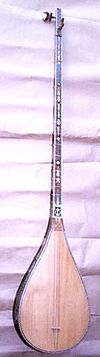
Duwtar tut, erik, g'oza ag'ashlarınan sog'ıladı. Duwtardın' qarnı on'g'a jaqın jupqa taxtakeshtı egıp, bir-birine japıstırılıp sog'ıladı. Onın' u'stinen qappaq jawıladı ha'm tayyar bolg'an qarın da'stegıne jalg'anadi.
Targir ya'ki tar ilgek duwtardın' eki sımın ko'terip turadı. Duwtardın' da'stesı jinishke uzın boladı. Basqa tarlı a'sbaplarda a'detde metal perdeler bolsa, duwtarda da'stesıne oralg'an 15 ke jaqın jipek perde boladı. Zamanago'y duwtarlardın' perdelerı ayrım gezlerde ag'ash ya'ki su'yekten sog'ıladı.
Duwtar da'stesı su'yek, sa'dep benen bezeledı. Duwtar tarları aldınları ishekten, keyin jipekten tayarlanatug'ın edı. Zamanago'y duwtar tarları neylonnan qılınadı.

Shertıw usılları

Duwtardı tu'rlı jollar menen shertıw mu'mkin. Jekke shertıw, qos shertıw, piripirek, rez uqsag'an usıllar menen shalınadı.

Siltemeler

  • Dutor, Graham Flett (inglisshe)


Wednesday, April 7, 2010

Dutars


Painted by Serekeev Bazarbay - Little Dutar Player (Source Karakalpak State Art Museum http://www.museum.kr.uz/eng)

The dutar (dutor or dotar) is the main plucked instrument all over Central Asia. It can be found in many different shapes and styles. Dutars are usually made from a single block of wood (Afghanistan, Iran, and also in Karakalpakstan), but the two largest traditional dutars those of the Uzbeks and the Uyghurs are made of staves.

The body of the Uzbek dutar is made from separate ribs (usually mulberry wood), glued together with often a narrow half round strip on the outside of the joins. The flat front is also made of thin mulberry wood. The soundholes are a few drilled holes in a geometrical design.


Uzbek dutar

The long thin neck (mulberry or apricot) includes the (straight) pegbox. The frets are made of silk strings and tied-on in half diatonic scale. At the left side is a groove in the neck to ease making the knots in the frets. There are two flat T-shaped friction pegs, one on the front, one on the left. The two silk strings run over a small loose bridge to a bit of wood at the edge of the body.

The neck is often highly decorated with inlay bone (or black/white plastic nowadays) in squares, triangles, lines. The top of the ribs have triangle inlays, together forming a kind of windrose. The entire instrument is varnished.

Left hand playing is with two fingers for the first string and the thumb for the second string. The right hand plays often in a rhythmic fashion with a different finger for each beat. But also normal strumming with the index finger is done.

Its sonority is grave and noble, and it can be played both for solos and interpretation of the classical repertoire. However these days it is mainly used to accompany popular songs.


Pavel Petrovich Benkov ("Girl with dutar") Source: http://www.bertc.com

See for more information on the dotar see sources: http://www.atlasofpluckedinstruments.com/central_asia.htm and http://www.cais-soas.com/CAIS/Music/dotar.htm