Monday, September 1, 2014

Djanbas Qala Fortress

Djanbas Qala, Fortress, 4th c. BC - 1st c. AD

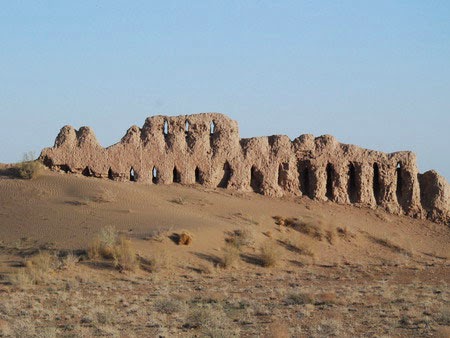
Djanbas Qala is located about 47km north east of To'rtku'l on a barren upland which closes a chain of hills stretching south-east from the Sultanuizdag range and is one of the oldest fortresses in the Republic. It was first excavated by the Khorezm Archaeological Expedition led by Sergey Tolstov in 1938.  The fortress was built in the 4th century BC to protect nearby agricultural settlements and is believed to have been destroyed by nomadic tribes who managed to break through the fort's defences sometime during the 1st Century AD. Materials collected on the site, mostly ceramics, are inherent to the early antique (Kangyuy) culture of Khwarezm.
 
The extant walls make a rectangle of 3.5 hectares in area each and are oriented towards the east, west, north and south. Covered with sand dunes in some places, these double, five-metre-thick walls reach up to 20 metres in height. Between the outer and inner walls of the fortress there is a 3-meter-wide passageway. The lower part of the walls, up to the level of the embrasures, is made from wattle and daub with streaks of brickwork; above the walls are made of adobe bricks. The only entrance to the fortress on the northwest side,

Djanbas-Kala is as such quite distinct from most other Central Asian fortresses as it has neither corner nor in-wall turrets but still provided a strong defence. Fortifications without turrets belong to  a very distant past, they are found neither in antique Mediterranean civilizations nor in the ancient Orient. Another interesting feature characteristic of Khwarazm traditions is the narrow corridor connecting the gate facilities so that the defenders could fire at the enemy from the battlements. Around the whole periphery the outer walls of the fortress there are two staggered rows of arrow-shaped embrasures. Between the rows, from inside, there were built wide ledges for the defenders to stand on. The narrow 20-centimeter-wide embrasures were specially designed to shoot arrows downwards towards the foot of walls and steep slopes facing outside. To better able defenders to repulse of the enemy on the flanks, the walls of the fortress were provided with a group of three specially arranged embrasures: the central one directed straight ahead at a right angle, and two side ones directed right and left respectively at an obtuse angle. Each group of embrasures (with apertures opening inwards) being arranged with a small arched niche provided with a space for one archer. Such systems in the walls alternated with a set of 20-30 ordinary embrasures. The corners of the walls also had pairs of embrasures looking sideways.

Excavations at Djanbas Qala have uncovered a large number of ceramic fragments, terracotta statuettes and various artefact's. Among them were bracelets, signet-rings, jade and crystalline pyrite beads, and, notably, a large number of glass beads of various shapes and colours. Such glass beads were wide-spread in the northern Black Sea area, which provides proof of well-established trade routes.

However, among the hundreds of artefacts there was not a single coin to be found, which proves that the town had existed in the 1st century the latest, as in Khorezm the first coins came into being only at the beginning of the 2nd century, in the times of the Great Kushans and Khorezmshakhs. he inhabitants were most likely farmers working in the fields outside the town. One of the excavations brought to light the remains of a tandur clay oven, whereas in other rooms of the dwelling there were discovered grain graters typical of Kanguy period.

The inhabitants worshiped Zoroastrianism, one of the world's oldest religions that spread for more than a thousand years over a huge area between Khorezm and India, and Xinjiang and the Middle East. Most scholars believe that it was Ancient Khorezm where Zoroastrianism originally appeared. It is impossible to establish either the exact date the religion originated, or the date of birth of its prophet Zaratustra (Zoroastr in Greek). Scholars only suppose that he lived sometime in the 7th – 6th centuries B.C.

The ruins of the temple of fire and the sun are located on a mound 4.5m high across from the main gate. The temple was the centre of the town's spiritual life. There can still be seen the remains of the oval pedestal that made up the altar, on which the holy fire used to burn day and night, as was required by the Zoroastrian religious rituals. Along the wall there is also a partly-ruined long stone bench for the priests who were to keep the eternal fire by feeding it with fruit tree twigs. It was the place where they performed the fire purification ceremony and sang Avesta hymns. The temple had also a large room where, judging by a great number of fragments of earthenware and animal bones inside it, the Zoroastrian dining ritual Boj Giriftan would take place.

Burials occurred outside of the city, where the dead were placed on the flat tops of Dakhma's "towers of silence" or in specific locations in the surrounding hills for vultures and animals to feed on. Then the bones of the dead would then be put in special ossuary containers. On the outskirts of Djanbas–Kala in the 1960s archaeologists discovered a large collection of such containers. Made of baked clay and covered with glaze they date back to the 1st century B.C. Most likely, the place these ossuary's were found in, was a kind of necropolis of Djanbas Qala. The containers were of various sculptural forms: a woman sitting on a throne or a horse-rider or in the form of a fortresses with arrow-shaped "chessboard order" embrasures, cornices and pilasters.
 
For five centuries Djanbas Qala residents had to repeatedly defend their town from hostile nomads. In the 1st century BC during one of these attacks invaders managed to break open the wall south of the main fortified gate by force using a ram, and burst inside. The enormous number of metallic arrow-heads of two types, found inside the town, testifies to a fierce fight that took place. Most defenders were probably killed, with those who were spared taken as slaves; the fire temple and dwellings were all destroyed. 

Over time the appearance of the Qala has slowly changed under the influence of water and wind and parts of the walls are almost covered by sand but much of the original structure whilst eroded is still intact.

Wednesday, August 27, 2014

Джанпык Кала

Джанпык-Кала крепость Djanpyk Kala Video (Russian) 4:39


•Джанпык-Кала. Городище IX-XI вв., XIII-XIV вв. н.э.


Городище расположено в 6 км юго-восточнее поселка Каратау, на юго-западных отрогах Султануиздагского хребта. Один из живописнейших памятников правобережной части Амударьи.

Городище в плане имеет сложную конфигурацию. В восточной части сохранилась цитадель в виде прямоугольника пахсовых стен. Стены украшены сомкнутыми полуколоннами и вершины кончаются попарно ступенчатыми арочками.

Археологические раскопки позволили уточнить хронологию городища. Древнейшая керамика относится к IV в. до н.э. - I в. н.э. Дата последнего обживания определяется монетами 1319-1320 гг. и 1345-1346 гг.

При раскопках обнаружены многочисленные находки ранее привезенные из различных стран Востока и Запада. (Китая, Египта, России, Европы, Индии). Городище служило портовым городом в средневековье.На окраине Джанпык-калы можно увидеть бескрайние просторы заповедника Бадай Тугай.


Ruines de l' forteresse Djanbas Kala

Djanbas Qala /Djanbas Kala (Video: French 8:55)


Ruines formidables d'une vaste forteresse Djanbas Kala ayant fonctionné du 1er siècle av. J.-C. au IVe siècle. Inscrit au patrimoine mondial de l'UNESCO ces forteresses furent la résidence des rois de Khorezm. La forteresse a été construite avec de solides murs massifs en briques d'argile séchées à l'air et selon un plan prédéterminé de trois ensembles : un espace cultuel avec en son centre un foyer circulaire zoroastrien, un fort surélevé servant de centre administratif et d'une vaste cour rectangulaire en contre bas destinées aux habitations et aux caravanes. Ceinturé de remparts, aujourd'hui cette forteresse est en ruine. Ces forteresse du dèsert de Kizil Koum s'étendaient dans une zone autrefois cultivée et boisée.

Source: http://sheherazade-voyages.fr/noukous

In English-

Djanbas-Kala is among the oldest Zoroastrian monument in Uzbekisran and is part of Karakalpakstans and Khoresms "The Golden Ring of Ancient Khorezm".

At the foot of Djanbas-Kala, among sand dunes, there are pitched Yurts where travellers can find lodging and rest in the shade on tapchan platforms under reed shelters, where they are treated to rich shurpa soup and refreshing tea with Asian sweets. After sunset on the endless night sky there appear myriads of unbelievably bright stars. And when the moon lights up above the ancient fortress, the eternal fire of Djamas-Kala seems to be still shimmering in the ruins of the temple.

Земля и вода - бесценное богатство Узбекистана (Land and Water - Precious Resources for Uzbekistan)

Credit : ZEF - UNESCO Source: http://www.zef.de/index.php?id=1796

Земля и вода - бесценное богатство Узбекистана (Russian) 21:47


 Land and Water - Precious Resources for Uzbekistan  (English) 21:51

Video: Kyzylkum desert. The nature of Uzbekistan.

Friday, August 22, 2014

Zoroastrian Ruins in Karakalpakstan (Monumentos Zoroastristas de Karakalpakstán)

 
Video 1. 'Zoroastrian monuments in Qoralqalpogiston. Ancient Khorezm sights' 8:43 (English)


Karakalpakstan and Khorezm (north west of Uzbekistan) the core territory of ancient Khwarezm is believed to be the birthplace of the Zoroastrian religion and has the richest area of Zoroastrian settlements, fortresses and temples in the whole of Central Asia. These include the magnificent ruins of the Mizdakhan with its huge necropolis (4th c BC), the settlement site Gyaur-Kala (4th c BC - 4th c BC), the dakhma ‘tower of silence’ and ossuary burial site of Chilpyk-Kala (4th c. BC - 11th c. BC), the ancient settlement of Toprak-Kala (1st c - 4th c) and the burial and astral cult site of Koy-Krylgan-Kala (4th c BCE - 4th c BC).


Photo Credit: Mizdakhan : http://grandgeocoucou.com/2013/09/09/le-journal/

 Video 2. 'Monumentos Zoroastristas de Karakalpakstán. Curiosidades de Khorezm'. 8:28 (Spanish) Go to Monumentos Zoroastristas


En el oeste de Uzbekistán, en el antiguo Khorezm, se han conservado numerosos monumentos de la época del zoroastrismo - las ruinas de antiguos asentamientos y muros de fortalezas zoroastrianas, construidas de pahsa (arcilla). Los más grandes de ellos son: citania Mizdahkan (s.IV adC) y su gran necrópolis, fortaleza Gyaur Kala (s.IV adC -- s. IV dC), dakhma Chilpik Kala (s. IV adC -- s. XI dC). El lugar ceremonial de los zoroastristas de entierro en osarios, el antiguo asentamiento Toprak-Kala (ss. I-IV dC) y el monumento funerario y de culto astral del zoroastrismo -- Koy-Krylgan- Kala (s. IV adC -- s. IV dC).


Photo: Chilpyk Kala - Tower of Silence - Credit www.panoramio.com/photo/62366723 
 
See my blog  entry Golden Ring of Ancient Khorezm for more details -

http://karakalpak-karakalpakstan.blogspot.com.au/2011/06/golden-ring-of-ancient-khorezm.html