Friday, October 23, 2015

DUWTAR

Duwtar

Source: QARAQALPAQ WİKİPEDİASININ' MAG'LIWMATI
 
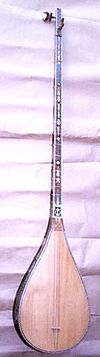
Duwtar (Parsısha: دوتار‎) — Orta Aziya, İran ha'm Qubla Aziyada tarqalg'an, eki tarli mu'zika a'sbabı. Atı parsı tilinen „eki tar“ ( دو duw — „eki“, تار tār — „tar“) dep awdarıladı. Biraq Xirat duwtarı on to'rt tarli boladı. Duwtar XV asr a'tiraplarında payda bolg'an.

Sog'ılıwı

Duwtar tut, erik, g'oza ag'ashlarınan sog'ıladı. Duwtardın' qarnı on'g'a jaqın jupqa taxtakeshtı egıp, bir-birine japıstırılıp sog'ıladı. Onın' u'stinen qappaq jawıladı ha'm tayyar bolg'an qarın da'stegıne jalg'anadi.
Targir ya'ki tar ilgek duwtardın' eki sımın ko'terip turadı. Duwtardın' da'stesı jinishke uzın boladı. Basqa tarlı a'sbaplarda a'detde metal perdeler bolsa, duwtarda da'stesıne oralg'an 15 ke jaqın jipek perde boladı. Zamanago'y duwtarlardın' perdelerı ayrım gezlerde ag'ash ya'ki su'yekten sog'ıladı.
Duwtar da'stesı su'yek, sa'dep benen bezeledı. Duwtar tarları aldınları ishekten, keyin jipekten tayarlanatug'ın edı. Zamanago'y duwtar tarları neylonnan qılınadı.

Shertıw usılları

Duwtardı tu'rlı jollar menen shertıw mu'mkin. Jekke shertıw, qos shertıw, piripirek, rez uqsag'an usıllar menen shalınadı.

Siltemeler

  • Dutor, Graham Flett (inglisshe)


Thursday, October 8, 2015

Traditional Karakalpak Music

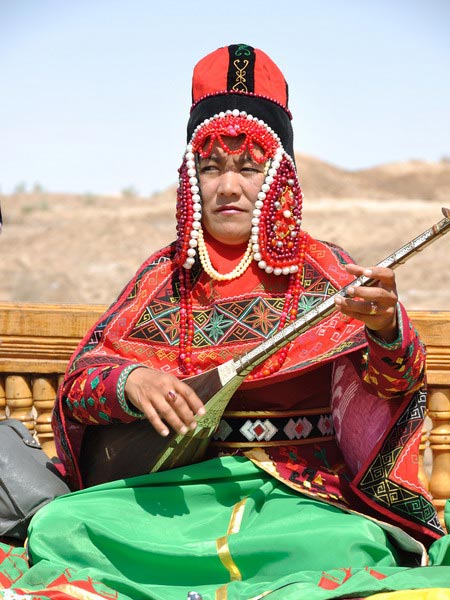
 Karakalpak musicTraditional Karakalpak music is multifaceted narration of poems and epics to the sound of traditional string bow instruments the qobuz (qobiz) and the duwtar (Dutar) and is closely connected with the oral folk tales and epics of their nomadic past.  It is transmitted by two key figures of this culture: the jiraw and baqsi both are poets, stortytellers and musicians at the same time. There traditional songs are divided into ritual kosiks: lullabies, funeral, wailing songs, wedding (synsu, bet ashar, korimlik). There's are also many love-lyric and historical songs in the national repertoire

The jiraw is a bard who specialises in heroic epics. He depicts in his singing, the courage and strength of heroes involved in titanic combats.
His narrative unfolds using a guttural tone and a deep voice reminiscent of the sound of his two-string fiddle, the qobiz. This instrument has a unique structure with two thick strings made from horse hair. The voice and the fiddle of the jiraw, as well as the content and values revealed in the epics  make an inimitable sound recreating the wild steepe of Central Asia.

As for the baqsi, there music stems from a rather different style. They sings epic poems, which instead celebrate courtly love, in a narrative style that describes the quest for love, either by an individual or a couple. The baqsi accompanies himself with a two-string lute, the duwtar (Dutar), while singing in a natural voice.
 
Jiraw (Throat singing) gained wide popularity from the end of the 18th century, when much of the most important Karakalpak literature and music was composed.

Such famous Karakalpak poets-musicians as Djien-zhirau (1730-1784), Kunkhodzhi (1799-1880) lived and worked during this period. They accompanied their stories with penetrating music trill, which gave a tragic, inimitable twist to their unique poems and epics. The Karakalpaks during most of the 18th -19th centuries were fighting for their independence from both the Kazakh and Khiva Khans. In this period the great tragedy unfolded as the Kazakh Khan Abulkhair pushed the Karakalpaks from the mid Syr Darya in the direction of Tashkent and Khorezm. A witness of these forced migrations, Jien-zhirau wrote the poem "The wandering nation", which reflected the darkest page of the history of the Karakalpak people.
The most famous exponent of baqsi during the 19th century was the national poet Ajiniyaz. His most famous works include "Buzatau", which tells of the Karakalpaks’ piligrimage and "Dzhigits" or in english "Other" which reflected his patriotic, humanistic and philosophical views.
 

Karakalpak musicAnother great Karakalpak baqsi was Berdymurad Kargabay ogly (known as Berdakh) who is justly considered to be a founder of the Karakalpak literature and was a noted baqsi singer much loved in his era. Berdakh regarded Navoi, Fuzuli, Kunkhodzhi as his teachers. His creativity began with the reading of verses to the tune of dombra, when he was 18 years old. Throughout his life he composed poems and runes on on mainly patriotic and historical themes.
 

Saturday, August 29, 2015

The origin and meaning of the word “Mazda”

Ahura Mazda (right, with high crown) invests A...Did you know that the Mazda Car is named after the Zoroastrian God Ahura Mazda?

The Mazda company’s name, “Mazda,” derives from Ahura Mazda,  the Zoroastrian god of wisdom, intelligence and harmony. Used by the company as a symbol of the origin of both Eastern and Western civilizations, and also as a mark of their automobile companies work culture. 

The ancient religion of Zoroastrianism was founded by its prophet, Zoroaster (Zarthusthra in Avestan) believed to have been born in ancient Khorezm near the town of Khojeli in Karkalpakstan. It is believed to have arisen during the 10th or 11th BCE, though some believe that he lived some time between 1750 and 1200 BC. And the Parsi people of India, Pakistan place him at about 6000 BC. Zoroastrianism is a peaceful religion and is all about doing good (its morality is summed up in the phrase “good thoughts, good words, good deeds”).

The car company Mazda began its life in 1920 as the Toyo Cork Kogyo Co. in Hiroshima, Japan. At the time, there was a cork shortage because of World War I, so the company was founded to process a cork substitute made from the bark of an Abemaki or Chinese cork oak tree. It was a good idea at the time, but shortly afterwards Japan could get real cork again and the company foundered.

In 1927, Jujiro Matsuda came onboard to lead the company and started manufacturing tools, three-wheeled "trucks" and then cars. After World War II, the company formally adopted the name Mazda named after the Zoroastrian god Ahura Mazda (and was close to an anglicized pronunciation of Matsuda the founder's name).

Logo: In the 1936 logo, the M shaped curve was inspired by the emblem of Hiroshima city. The 1991 and 1992 logos symbolized a wing, the Sun and a circle of light. Mazda's current logo, nicknamed the "owl" logo, is a stylized "M" that look like stretched wings.

Monday, August 17, 2015

Monuments of ancient art of Karakalpakstan

At the lower reaches of the Amu Darya is located the Khorezm oasis, whose fertile lands are surrounded by deserts of Karakum, Kyzylkum and vast open spaces of the Aral – Caspian.

Within this rich delta nowadays divided today among Rep. of Karakalpakstan, the Khorezm region (both in Uzbekistan) and the Dashkhovuz viloyat of Turkmenistan, in far antiquity arose and blossomed the civilization of ancient Khoresm. Many outstanding monuments of art have been found belonging  to this extraordinary and mysterious Civilization.

It is as ancient as the great civilizations in Egypt, Mesopotamia and India. Almost three thousand years of continious civilisation making it the oldest in Central Asia.  Its unique architectural monuments also compare to the Egyptian pyramids and Iraqi Zigurats and Greek temples very different from culture of other regions of Central Asia.

Archeologists have found magnificent examples of ancient Khwarazmian art including numerous finds of terracotta, clay statues and bas-reliefs, frescos and ceramic ossuaries enabling them to learn a lot about about the life of ancient population of the delta lands.

Khwarazmian painting and sculpture, whose development was integrally linked to that of architecture, glorified fertility and deified the power of the king; typical examples of this art are the painted clay statues and bas-reliefs and the multicolored decorative paintings, executed in natural pigments, that were found at Toprak-Kala. A unique form of Khwarazmian art are the ceramic ossuaries in the form of statues (fifth century B.C. to the early Common Era), which present a stylized image of the deceased. Terra-cotta statuettes, fashioned throughout Khwarazm, depict goddesses of fertility in a style that reflects the tradition of the Southwest Asian kore; other terra-cotta statuettes include small figurines of horses and, more rarely, men in “Scythian” dress. Typical of the fourth and third centuries B.C. are ceramic flasks with bas-reliefs depicting mythological subjects.

Sources:

See the article in Sanat by Professor Vadim N. Yagodin Head of the Department of Archaeology, Research Institute of the Humanities of Karakalpak branch of Academy of Sciences of Uzbekistan for more detailed information.

http://encyclopedia2.thefreedictionary.com/Khwarazm

Monday, June 29, 2015

AL-KHOWARIZMI AND THE CONCEPT OF ZERO

Al Khowarizmi - Great Khwarazmian Mathematician -  Inventor of the loarithm algorithm and the usage of zero in mathematics and the word algebra originating  (الجبر al-jabr "restoration") from the title of his book Ilm al-jabr wa'l-muḳābala.
 
The Stamp from the  OJSC "Uzbekistan pochtasi" and put into circulation by the State Committee of Communication, Information and Communication Technologies of the Republic of Uzbekistan from April 10, 2014 as a standard postage stamp. 


The ancient Indians represented zero as a circle with a dot inside. In Sanskrit, it was called "soonya". This and the decimal number system fascinated zIslamic scholars who came to India. Al-Khowarizmi (790 AD - 850 AD) wrote Hisab-al-Jabr wa-al-Muqabala (Calculation of Integration and Equation) which made Indian numbers popular. "Soonya" became "al-sifr" or "sifr". The impact of this book can be judged by the fact that "al-jabr" became "Algebra" of today. An Italian Leonardo Fibonacci (1170 AD - 1230 AD) took this number system to Europe. The Arabic  "sifr" was called "zephirum" in Latin, and acquired many local names in Europe including "cypher". Today this system is called Hindu-Arabic System.  The positional system of representing integers revolutionised the   mathematical calculations and also helped in Astronomy and accurate  navigation. The use of positional system to indicate fractions was introduced around 1579 AD by Francois Viete. The dot for a decimal  point  came to be used a few years later, but did not become popular  until its  use by Napier. The binary system used in modern computing uses 1 and 0.
 

AL-BIRUNI, Abu Arrayhan Muhammad Ibn Ahmad

Abou Rayhan Mohamed Al Biruni (973-1048) was born at Kath in Khwarazm (now Beruni) located in the modern day Republic of Karakalpakstan (in Uzbekistan). He was an outstanding astronomer, astrologer, mathematician, physicist, physician, geographer, geologist, historian, and indefatigable traveller. Conversant in Turkish, Farsi, Sanskrit, Hebrew and Arabic and Hindi, he became the most important interpreter of Indian science to Islam. His many scientific achievements include: pioneering the notion that the speed of light is much greater than the speed of sound, disputing the European Ptolemaic view that Africa stretched infinitely to the South, insisting it was surrounded by water, advancing the controversial but correct view that the Indus valley was once a sea basin, and explaining natural springs by the laws of hydrostatics.

Al-Biruni studied with the renowned astronomer and mathematician Abu Nasr Mansur, a prince of the ruling Banu Iraq in Khwarezm. Al-Biruni’s knowledge of several languages allowed him to understand existing ideas and bring a fresh and original approach to his own work. At 17 he computed the latitude of Kath by observing the maximum altitude of the sun. By the time he was 21 in the year 994, he had written several short works. One that survived is Cartography, a work on map projections. He regularly corresponded with his contemporary, the famous physician Ibn Sina better known to the West as Avicenna, who reconciled Greek learning with Muslim thought with his translation of Euclid into Arabic.
At the end of the 10th century and the beginning of the 11th century there were numerous civil wars in the region where al-Biruni lived. In 995 the rule of the Banu Iraqi was overthrown in a coup that forced al-Biruni to flee but to where is not quite clear. Some theorize by analyzing his writings that he then went to the city of Rayy, near  present day Tehran, where he had no patron and lived in poverty. It is known he returned to his homeland by June 4, 1004, which then was ruled successively by brothers Ali ibn Ma’mun and Abu’l Abbas Ma’mun who provided generous support for al-Biruni’s scientific work. Here he described an eclipse of the moon from Jurjaniyya, (modern Kunya- Urgench, Turkmenistan) in collaboration with his teacher Abu Nasr Mansur, but at the cost of not being free to leave. He was to spend the next seven years in the court of Prince Khwarimshah Abou Al Abbas Ma’moum. In  1017 Sultan Mahmud of Ghazni (in Afghanistan) conquered Abu’l Abbas Ma’mum’s kingdom even though both Abu’l and his brother had married Mahmud’s sisters.

This political upheaval did not interfere with al-Biruni’s research. On the contrary, his scholarship so impressed Mahmud that he took the scholar with him on his military excursions in India. Over a period of 20 years he traveled all over the country, learning Hindu philosophy, mathematics, geography and religion from the Pandits, and in turn he taught them Greek and Arabic science and philosophy. His long stay allowed him to learn the Sanskrit which enabled him to make contact with the greatest scholars of this country exchanging with them his knowledge from the Baghdad school against that of India. Upon his return to Afghanistan, all the knowledge from his observations of his travels in India were recorded in his book Kitab al-Hind. In this work he mentions that he translated two Sanskrit books into Arabic. One, named Sakaya, which dealt with the creation of things and their types, and the second, Patanjal, examining what happens after the soul leaves the body.

On returning from India, al-Biruni settled in the court of Gazna (now in Afghanistan), with Sultan Massoud to whom he dedicated his third main work entitled Qanun-I Masoodi, a book in which he discusses several theorems of astronomy, trigonometry, solar, lunar, and planetary motions. That same year, Al Biruni composed his Kitab al tafhim li awa′il sina′at al tanjim (“Book of Instructions in the Elements of the Art of Astrology”), also known as the Tafhim. In this book he follows a logical progression from first principles, beginning with geometry, then arithmetic, astronomy, geography, chronology and a discussion of the astrolabe before reaching his introduction to astrology. He described the general characteristics of the “planets,” Saturn, Jupiter, Mars, the Sun, Venus, Mercury, and the Moon and describes their role in determining people’s actions and professions, their bodies and diseases, animals, vegetables & minerals. As an illustration, he claimed Saturn rules farming, grave-digging, captivity, fathers, slaves, wicked people, hair, skin, bones, old age, sickness, poverty, death, horses, olive trees, almonds, hard stones, lead, pepper, sleep, and poisons. These are only a small sampling of those things ruled by Saturn, and in a like manner the other six “planets” rule as many things.

Among his other books is the al-Athar al-Baqia in which he connects accounts of ancient histories of nations with known geographical facts. In it he also discusses whether or not the Earth rotates on its axis, and gives the correct longitudes and latitudes of several places. His treatise Kitab-al-Saidana contains the then existing Arabic knowledge of Indian medicine.
It is believed over his lifetime that al-Biruni wrote some 180  books and articles, with only about a fifth having survived. One of his most important texts is Shadows, which covers shadows, gnomonics, the history of the tangent and secant functions, applications of the shadow functions to the astrolabe, shadow observations for the solution of astronomical problems and for the fixing of times for Muslim prayers. In addition, al-Biruni gave a full description of the Hindu positional principle of numeration and proved Heron’s formula and Brahmagupta’s generalisation. In physics he studied specific gravity and the causes of artesian wells.

In Kitab-al-Jamahir, al-Biruni became the first to determine the hardness of minerals and their specific weights. He described the ratios between the densities of gold, mercury, lead, silver, bronze, copper, brass, iron and tin. He displayed his results as combinations of integers and numbers of the form 1/n, with n = 2, 3, 4,…, 10. He was the first to see gas-liquid inclusions in gems – ancient fluids that took part in the formation of mountain crystals, topaz, amethysts, sapphires, ambers, and other minerals. He was also an astrologer who astonished people with the accuracy of his predictions.
Al-Biruni died at the age of 75, having spent 40 years gathering knowledge and significantly contributing to science. He is said on his death bed to a former student  “Isn’t it better that I leave the world knowing the solution to this problem than leaving it without knowing ?” I then repeated the question to him and he gave me the solution he had previously promised me.  A few seconds later, the great scholar took his last breath”.

Source: http://www.robertnowlan.com/pdfs/al-Biruni,%20Muhammad.pdf (ED)

Friday, June 19, 2015