Showing posts with label Genghis Khan. Show all posts

Friday, January 1, 2016

Ghenghis Khan and his influence on Uzbekistan


The rule of Khwarezm shahs came to an end in 1220  when Mongol armies under Genghis Khan swept through the country.

After the conquest of China in 1218 Genghis Khan started plans for the invasion of Mawarannahr. In 1218-1219, a host of Mongols under the command of Ghengis Khan's general Jebe (the arrow) occupied the Kharnate of Kara-Khitan (now western china). In September 1219. Ghengis Khan came to Otrar, where he divided his army  one under the command of his sons Ogadey and Chagatai to siege Otrar; another was given to Jochi and sent in the direction of Jend for the seizure of the towns along the banks of the Syr-Darya while he himself, with his son Tolui, headed for Bukhara.


The Khwarezm Empire which at that time controlled Mawarannahr (today's Uzbekistan) was not ready for the invasion of such a powerful enemy. The Mongols conquered and destroyed the oasis cities one after another. They first sacked Bukhara in February, Samarkand in March and by the autumn of 1220 Termez. When the mongols attacked Urgench (now Kunya-Urgench) in April 1221 the Khorezm Shah Muhammad beat a hastily retreat leaving his eldest son, a talented military commander Manguberdi to defend against the Mongolian invasion. It is said that Ghengis Khan oldest son Jochi engaged in negotiations with the defenders trying to get them to surrender so that as much of the city as possible was undamaged. This angered his older brother Chaghatai, and Genghis headed off this sibling fight by appointing Ögedei the commander of the besieging forces as Urgench fell. But with the removal of Jochi from command the Mongol forces proceeded to sack the city with great ferocity. As usual the artisans were sent back to Mongolia, young women and children were given to the Mongol soldiers as slaves, and most of the rest of the population was massacred.  Then came the complete destruction of the city of Gurjang. Upon its surrender the Mongols broke the dams and flooded the city, then proceeded to execute the survivors. It is said by historians that up to 1 million people were killed during the sacking of the cities and towns of Khoresm oasis; making it at that time (and holding right up until the carnage of the 20th century) the bloodiest massacre in human history. According to legend Genghis Khan is famously quoted as saying "I am the punishment of God. If you had not committed great sins, God would not have sent punishment like me upon you".
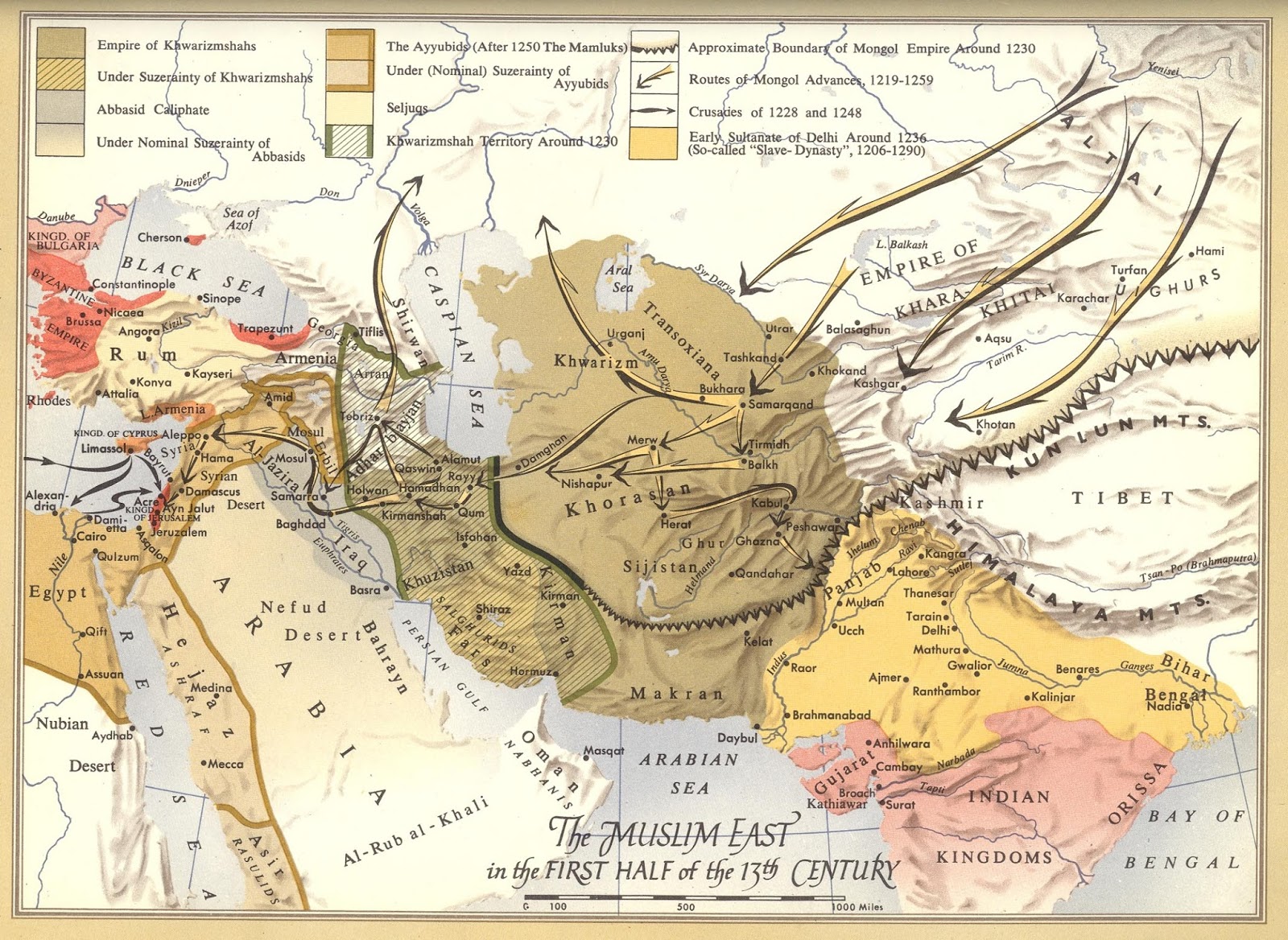
The Mongol invasion of Central Asia which took place from 1219 to 1225 is one of the turning points in the history of the region and led to a wholesale change in the population of Mawarannahr. The conquest quickened the process of Turkification in the region because, although the armies of Genghis Khan were led by Mongols, they were made up mostly of Turkic tribes that had been incorporated into the Mongol armies as the tribes were encountered in the Mongols' southward sweep. As these armies settled in Mawarannahr, they intermixed with the local populations, increasingly making the original Iranian speaking inhabitants a minority. Another effect of the Mongol conquest was the large-scale damage the warriors inflicted on cities such as Bukhoro and on regions such as Khorazm. As the leading province of a wealthy state, Khorasm was treated especially severely. The irrigation networks in the region suffered extensive damage that was not repaired for several generations.

After the death of Genghis Khan in 1227 his vast empire split into several parts governed by his sons and grandsons. The northwest part of Uzbekistan joined the Golden Horde, possession of Genghis Khan’s firstborn Jochi, and the remaining part of the country known as the Chagatai Ulus passed to his brother Chaghatai (1227-1241). Despite the potential for serious fragmentation, Mongol law maintained an orderly succession for several more generations, and control of most of Mawarannahr stayed in the hands of direct descendants of Chaghatai, the second son of Genghis. This orderly succession allowed prosperity and internal peace to prevail in the Chaghatai lands, and the Mongol Empire as a whole remained strong and united for more than a century after the great Khan's passing.


Chaghatai's descendant  Khan Kepek (1318-1326), a Jagataid, moved his capital to Maverannehr (now Uzbekistan and southern Kazakhstan). He built a palace near Nesef, which became the core of a large new city of Karshi (administrative centre of the present-day Kashkadarya vilayet). During the reign of his son Tarmashirin (1326-1334) who had converted to Islam, friction developed between two fractions of Mongol nobles; one faction advocated adopting Islam and settled lifestyles, and the other faction strongly adhering to nomadic traditions and pagan beliefs. This strife culminated in the country’s division into Maverannahr proper and Mogulistan. Further as a result of collisions between the two movements and feudal factions, in the late 1350s the Jagataids domain dissipated into more than a dozen petty states.

An interesting aspect is that Temudjin fathered so many offspring than recent genetic studies have found that in fact that of the current population of Central Asia that up to 1 in 10 are likely to be his descendants. This is a source of great pride and I understand that my own kids being Kipchaks are likely decedents as are many other Karakalpaks, Kazakhs and Uzbeks in both Karakalpakstan and in Uzbekistan as a whole.

Numerous studies by teams of biochemists, based on the Y-DNA of modern descendants of Genghis Khan, have indicated that Genghis Khan may have belonged to Haplogroup C-M217. The suggested 25 Marker "Genghis Khan" Y-DNA Profile is:  

Y-STR Name385a385b388389i389ii390391392393394426437439447448449454455458459a459b464a464b464c464d
Haplotype121314132925101113161114102622271211188811111216
Zerjal et al. (2003) identified a Y-chromosomal lineage present in about 8% of the men in Central Asia.

Friday, February 20, 2015

Khwarezm's Forgotten Empire

Khwarezm or Chorasmia covered the Amu Darya River Delta (that forms a large oasis) in western Central Asia, it was bordered to the north by the Aral Sea, the east by the Kyzylkum desert, on the south by the Karakum desert, and to the west by the Ustyurt Plateau. The first inhabitants started to settle the region from the V century B.C. Early tribes included the Massagatae, Scythians/Sakas (Samaritans), and the Soghdians  These steppe cultures were an extension of a larger Eurasian series of horse cultures and spanned both Indo-Europeans and Turko-Mongol language families. The area of Khwarezm was under Afrighid and then Samanid control until the 10th century before it was conquered by the Islamic Ghaznavids. During these periods waves of Turkic migrations changed the previous character of the region. On the decline of the Ghaznavids in 1041,  Khwatezm became a province of the rising Seljuk Sultanate.  
                                             Furussiya
In 1077 the Seljuks gave Khwarezm to Anush Tigin Gharchai, a Mamluk of  Kipchak origin. (Mamluks were "slave-soldiers" from nomadic Turkic tribes). Enslaved by Islamic sultans or emirs in their early childhood, they were given an education in  Furussiya "the art of war" which included tactics and strategy and emphasised skills in hand fighting, handling of weapons, hunting, horse-riding, falconry, archery, running, swimming, and other strategic games such as chess, drafts and backgammon. When they came of age they were enlisted in the ruler's army, and formed the heavy cavalry element of it's battle order. Elder Mamluks could rise to become Emirs or governors themselves, and so it was for Anush Tigin Gharchai. Regarded as the first of the Khwarezm-Shahs who ruled Khorezm and at times much of the surrounding region from 1077 - 1231

During Anush Tigin Gharchai rule Khwarezm was nominally as an independent state, but viewed as a client-kingdom of the Seljukid Sultanate. In 1141, however, a joint Seljuk and Khwarezmian army was destroyed by the Kara Khitai Khanate (Karakhanid Turks) led by Yelu Dashi. Allah ad-Din Aziz, grandson of Anush Tigin Gharchai, was forced to submit to their rule. In 1156  Il-Arslan succeeded his father and whilst he continued to rule under the Kara Khitai  they were more and more independent and by the reign of his son Allah ad-Din Takash (1172 - 1200) the Khwarezmians felt confident enough to challenge both the Kara Khitai and the Seljuks openly. A charismatic leader and a talented general he inflicted defeats on the Kara Khitai and declared an independent Khwarezmian State, he then moved against the fragmented Seljuk Sultanate. In 1194 in an alliance with Caliph Al-Nasir he won a great victory over the Seljuks. The Seljuk sultan himself, Toghrul the Third, fell under a storm of Khwarezmian saber-strokes as his army was routed.  After the war, he broke with the Caliphate and was on the brink of  war with it until the Caliph accepted him as Sultan of Khorasan, and Turkestan in 1198. By the end of the 12th Century, the Khwarezmains had developed a reputation for fielding the most deadly heavy cavalry in all of Central Asia - if not in all of the Dar al-Islam.

In 1200 Allah ad-Din Takash was succeeded by his son, Allah ad-Din Muhammad.II (1200–1220)who guided Khwarezm to her brief moment of glory. Taking advantage of the relative anarchy following the Seljuk collapse, he extended Khwarezm's territories far to the south. By 1205 in addition to Khwarezm he was ruling very nearly all of Iran, and had taken the title of Khwarezmshah - King of Khwarezm. At its peak Khwarezm ruled much of Central Asia from the eastern borders of Iraq to the western borders of India. Both settled Persian cities and wild Turkish tribes owed allegiance to the Shah, and sent contingents of soldiers and warriors to serve in his impressive army. Khwarezm was a very highly militarised state; much of the artwork of Central Asia in the early 13th Century celebrates the Khwarezmian Army - particularly its famous heavy cavalry .The Empire reached its highest point in 1212, when Shah Muhammad conquered the territories of its former rulers, the Kara Khitai . But the fires of Khwarezm's triumphs, however brightly they burned - were about to be snuffed out in a quick and decisive fashion, by the most brutal conquerors of them all Ghengiz Khan.
Khwarezm and Mongol Empires in 1220

It is a matter of opinion as to whether Khwarezm's greatest Shah, Allah ad-Din Muhammad was incredibly brave or incredibly stupid (the two have rarely been mutually exclusive). Had he known the fates that befell countries who showed insolence to Genghis Khan, it is very likely he would have behaved differently when a band of Mongolian merchants arrived in the Khwarezmian city of Otrar in 1218. Suspecting they were spies sent by the Khan, the governor of Otrar executed the Mongols. When Genghis Khan expressed his outrage, Shah Muhammad condoned his governor's actions. It was to prove a fatal mistake. In 1220, Genghis Khan took his revenge and began his invasion of Khwarezm, riding at the head of an army of 200,000 troops. Their ranks were swelled by neighbouring Turkic tribesmen who had resented the Kharezm-Shahs for past defeats.
Gengiz Khan on the Pulpit in Bukhara

The Khan's army moved so quickly, that Shah Muhammad did not have time to form a force that could effectively oppose it. He fled to the west, leaving his Kingdom to its fate. Across Khwarezm soldiers and local militias attempted to resist the Mongols, but did not manage to stop or even slow down their murderous advance on the finest cities of the Empire, Samarkand, Bukhara, and finally the Khwarezmian capital of Urgench. Each was sacked and its inhabitants put to the sword. Some historians go as far as to say that the invasion of Khwarezm was the most brutal war the Mongols ever undertook; effectively a genocide.

Shah Muhammad fled in shame and grief to an obscure island in the Caspian Sea, where he died in exile later that year. In the meantime, his son Jalal ad-Din Mangubirdi attempted to organize Khwarezmian resistance against the Mongols. Too late to save any of the Empire's cities, after fighting a rear guard action was able to flee towards India with his army of 5000 heavy cavalrymen. 

In 1221 Jalal ad-Din's army was attacked, enveloped, and nearly totally destroyed by a Mongolian  army led by Ghengiz Khan himself along the banks of the Indus. Less than 700 of his Khwarezmians escaped, including Jalal ad-Din himself. He evaded a detachment of Mongol pursuers only by jumping off a high cliff over the Indus, and swimming to the other side of the River. Genghis Khan is said to have called to his sons and pointing at Khwarazm Shah said, “Look at the brave man.” and remarked "fortunate is the father of such a son!"

Jalal-ad-Din crosses the Indus to escape the Mongols

Jalal ad-Din, accompanied his small retinue of Khwarezmian survivors, fled into exile in Dehli. Ashamed at his defeat, he revoked the title of Shah but still allowed himself to be called a Sultan. He received word not long afterwards that his family had been captured by Genghis Khan, and executed by being drowned in the Indus. His eldest child had only been 8 years old.

He was to spend three years in India, gathering support and plotting to retake his father's kingdom,  returning to Khwarezm in 1224. On his return he found his people - those who survived - filled with hatred of the Mongols, and it did not take him long to gather a large army bent on re-conquest and revenge. He declared a revived Khwarezm state, but it was to last only a year before it was once again defeated by a Mongol army, this time in the Alborz Mountains. Jalal ad-Din and his small army however proved frustratingly hard to destroy. He men once again became nomadic horse-warriors; those who still had wives and children brought them with them. The kingdom of Khwarezm became, if only for a short time, a state on the move. But by late in 1225 Jalal ad-Din captured and settled his people in Tabriz in Azerbaijan, along the western shores of the Caspian Sea. Here, he had a set of hostile neighbours including the Christian Kingdom of Georgia, and the final remnant of the Seljuk Sultanate - the Sultanate of Rum. Jalal ad-Din had again proven to be a charismatic leader whose men were tough and dedicated soldiers. Skirmishing that same year took place between the Khwarezmians and the Georgians along their border which finally erupted into a short war. A larger Georgina force being outwitted by Jalal ad-Din and his cavalry at the Battle of Garni fought in 1225 in the Armenia highlight then part of the Kingdom of Georgia. Next the Khwarezmians moved on the Georgian capital of Tbilisi raising the city. During 1226 they raided through Armenia, skirmishing with both Seljuk and Ayyubid soldiers.

In 1229, he once again decided to enlarge his domain attacking al-Jazirah (Mesopotamia), but was crushingly defeated by Sultan Kayqubad I of the Sultanate of Rum, at the Battle of Yassi Chemen. After the battle Jalal ad-Din fled to Diyarbakir the capital of todays Turkish Kurdistan where not long after he was assassinated. Some accounts say that his killer was a Seljuk or Hashashin, others claim he died in an ambush by Kurdish bandits. His legacy was a mixed one, proud, impetuous, and famously courageous Jalal ad-Din however was in the end unable to overcome the enormous odds he faced. His great personal valour and belief in his people however are still are held in high esteem throughout Uzbekistan in particular Khoresm province.
 
The story of the Khwarezmians did not end with the death of Jalal ad-Din, if anything, some of their most painful defeats and unexpected adventures still laid ahead.  Upon his death the remnants of the Khwarezmians were driven out of Tabriz by the Mongols joining up with those who had survived the defeat at Yassi Chemen, and formed a mercenary company. For the better part of a decade, the Khwarezmians spent their time pillaging settlements in Armenia, Syria, and Iraq, attacking Seljuk holdings with a special vengeance and loathing. During this time period, they came to call themselves by their Arabic name: the Khwarezmiyyas.

In the early 1240's, the Ayyubid Sultan Salih Ayyub called upon the Khwarezmiyyas to support him in a war against a pretender to his throne, his own uncle Salih Ismail. The wild mercenaries proved impossible to control, however, and apparently on a whim attacked Jerusalem in July of 1244 that was in the hands of Frankish Crusaders. On August 23rd of 1244, Jerusalem surrendered to the Khwarezmiyyas, who proceeded to occupy the Holy City before transferring it into Ayyubid hands.
Battle of La Forbie

Later, in October of 1244 the Khwarezmiyyas were instrumental to the Ayyubid victory over a mixed Muslim and Christian force at La Forbie, to the north of Gaza. It was the largest massacre of crusader knights to take place since the Battle of Hattin in 1187, and it deepened the bitterness between the Khwarezmiyyas and the Crusaders. The sack of Jerusalem and the Ayyubid victory at La Forbie triggering the unsuccessful Seventh Crusade. Jerusalem capture is particularly noteworthy as it ended European control for the next 500 years which was not again reasserted until the defeat of the Ottomans in 1917.

Within time the Khwarezmiyyas however were to fell afoul of their Egyptian employers and by 1246, they were in revolt against the declining Ayyubid state, but were crushingly defeated by Ibrahim al-Mansur. Those who survived were absorbed into the ranks of Egypt's Mamluks, who were soon to enjoy a period of turbulent glory themselves.

Source: http://historum.com/middle-eastern-african-history/14624-islam-s-forgotten-empire.html (Edited ED)

Saturday, December 28, 2013

Jalal ad-Din Mingburnu - A Short Biography of Khorezms most famous son

Photo: Jalal ad din Manguberdi

Jalal ad-Din Mingburnu al-Khwarazmi (full name: Jalal ad-Dunya wa ad-Din Abul-Muzaffar Manguberdi ibn Muhammad) or Jaloladdin Manguberdi (Turkic for "God-given"), also known as Jalâl ad-Dîn Khwârazmshâh, was the last ruler of the Khwarezmian Empire. Following the defeat of his father, Ala ad-Din Muhammad II by Genghis Khan in 1220, Jalal ad-Din Mengübirti came to power but he rejected the title shah that his father had assumed and called himself simply Sultan. After the fall of Samarkand Jalal ad-Din with the remaining Khwarazm forces beat a forced retreat into Afghanistan, while pursued by a Mongol army. At the battle of Parwan, north of Kabul, the Khwarezmians with local Afghan Tajik allies defeated the Mongols (ED: the only time in Gengiz Khans lifetime that the Mongols were defeated in battle -  Interestingly even to this day no foreign army however mighty has ever been able to hold sway in Afghanistan).

After being deserted by his Afghan allies (as legend has it over a dispute about whom would have the white steed of the defeated Mongol General) the Mongols regrouped and soon after Jalal ad-Din and his troops were forced to flee towards India. On the left bank of the Indus River, however, the Mongols caught up with the Kharwarezms and at what has become known as the Battle of Indus inflicted a major blow against his army, killing most of his men along with slaughtering thousands of civilians with his army. He and his core followers famously putting up a heroic struggle against huge odds along the banks of the river, with the survivors including Mingburnu escaping across the Indus.


Jalal ad-Din Mingburnu was to spend the next three years in exile in India. Entering into an alliance with the Khokhars he captured Lahore and much of the Punjab. The next year he requested an alliance with Iltutmish against the Mongols. However the Sultan of Delhi refused, not wishing to get into a conflict with Genghis Khan and instead marched towards Lahore at the head of a large army. Mingburnu retreated from the city and moved towards Uchch inflicting a heavy defeat on its ruler Nasir-ud-Din Qabacha, and occupied Sindh and northern Gujarat before returning to Persia in 1224.


Once again he gathered an army and briefly re-established a kingdom, however he was unable to consolidate his power for long as once again his forces were pursued by the Mongols who met his forces in battle in the Alborz mountain range (located in northern Iran  stretching from the border of Azerbaijan along the western and entire southern coast of the Caspian Sea) after which he and his men had to make a forced crossing of the Caucasus whereupon they captured Azerbaijan in 1225, setting up their capital at Tabriz. After initially forming an alliance with the Seljuk Sultanate of Rûm against the Mongols, Manguberdi fell out with them and his forces went on the attack once more in 1226 sacking Tbilisi (capital of the Kingdom of Georgia). Several years of skirmishes were to follow and in 1230 his army captured the town then Armenian city Akhlat (now situated in Turkey) from the Ayyubids. However his forces were overextended and in 1230 where defeated by Sultan Kayqubad I the Seljuq Sultan of Rûm at Erzincan on the Upper Euphrates at the famous Battle of Yassıçemen (Yassi Chemen).

Once again he and a core group of followers managed to escape into the Mountains of Kurdistan finding refugee in the city of Diyarbakir, however in the ensuring confusion the Mongols capture his previous stronghold of Azerbaijan. (ED: Diyarbakir today is one of the largest cities in south eastern Turkey and in the heartland of the Kurdish struggle for self determination). Diyarbakir was to be his last sanctuary, as he was assassinated there in 1231 by a Kurdish assassin hired by the Seljuks.


Manguberdi's loyal followers, however, remained loyal to him even after his death, transforming themselves into a mercenary force called the Khwarezmiyya. Thirteen years later they made history when in pay of the Ayyubid Sultan Salih Ayyub of Egypt, the Khwarezmiyya they invaded Christian-held Jerusalem, capturing the city's citadel, the Tower of David; and on July 11, 1244, forcing the surrender of the crusader army. Of great note is that after being conquered by the Khwarezmiyya, Jerusalem would stay under control of Islamic sovereignty until 1917,  near the end of World War I, when it was taken from the Ottomans by victorious British and Commonwealth forces.(ED: The Australian Light Horse brigade playing a critical role in the battle).

 
Video: Jalal ad-Din Mingburnu (2:08)


Source: http://en.wikipedia.org/wiki/Jalal_ad-Din_Mingburnu