Sunday, November 15, 2015

Catastrophic collapse of saiga population in Central Kazakhstan


In the northern summer a  catastrophic die-off  hit the largest population of the Critically Endangered saiga antelope Saiga tatarica located in central Kazakhstan. 

This virulent mysterious epizootic illness caused herd fatality of 100% once they were infected. It is estimated that more than 120,000 saiga were lost, some 40% of the species' total worldwide population of 250,000.

The deaths have been attributed to the Pasteurella bacterium an opportunistic pathogen that weakens the immune system.  It seems also likely that a number of environmental stress factors were involved that made the Saiga susceptible to the bacterium. An international team has been put together to investigate the deaths.

Source: For more information on the species see Saiga Conservation Alliance publication 
http://www.saigaresourcecentre.com/saiga-news

Wednesday, November 11, 2015

New Helicopter Mi-8 MTV for Uzbekistan Airways

Uzbekistan Airways has purchased for 12.7 million an Mi-8 MTV-1 multi-purpose helicopter produced by Russian Helicopters in Kazan. Unique in its functionality it will be soon added to the existing fleet of nine helicopters.


Unlike most other ex-USSR states, Uzbekistan keeps its special-purpose aviation under government control. The dedicated operator, Special Aviation Services (SAS), was founded in 1997, initially as an arm of the national carrier Uzbekistan Airways aimed at optimizing the mother company’s structure. At present, SAS has its own air operator certificate and a document entitling it to provide MRO services, both issued by the Uzbek aviation authority.


In April 2015 the company increased its fleet with ninth Mi-8MTV-1 heavy transport helicopter that was delivered under a contract with Russian Helicopters. SAS helicopters are based at Sergeli airfield 7 km to the south of Tashkent. The company uses these rotorcraft in a variety of roles, including for snow patrol flights and for carrying tourists to skiing resorts. The helicopters are overhauled in Russia with MRO work performed by St. Petersburg-based provider Sparc.


The Mi-8 MTV-1 is a unique multi-purpose helicopter, based at the Mi-8T model. The helicopter as a cargo helicopter can transport up to 4,000 kg of various kinds of cargo either inside the cabin or on an external sling. Used as a passenger helicopter is can carry up to 26 passengers & crew and boasts low levels of noise and vibration, is fitted with cabin climate-control systems, and has emergency exits that meet the latest safety standards. Everything is designed to ensure passenger in-flight comfort and safety.

Mi-8 helicopters are built at Ulan-Ude Aviation Plant and by Kazan Helicopters. More than 12,000 Mi-8 helicopters have been produced to date – a record for twin-engine helicopters anywhere in the world. They have been supplied to more than 100 countries worldwide and racked up total flying time of about 100 million hours.


Source: http://www.uzdaily.uz/

Also see Commercial Helicopters in Uzbekistan
 

Tuesday, November 10, 2015

Transcaspian Urial (Ovis vignei arkal) - Endangered Species

INTRODUCTION  Locally known as  the Arakal  in the Ustyurt region of Central Asia. 

Preferring gentle mountain slopes and plateaus, the graceful and high-legged urials are adjusted to moving deftly on rolling terrain. The weakening of the nature reserve system has led to increased poaching combined with overgrasing by domestic livestock in their range the numbers of urials have drastically declined now the total number in the wild are believed to be less than 5,000. 


DESCRIPTION The horn length of an adult male is up to 110 cm. Shoulder height up to 99 cm. Weight up to 90 kg. Females can weigh up to 45 kg. A large, bright-coloured, very handsome urial. Adult rams have a white bib and a long, white neck ruff; immature males have a smaller, dark neck ruff. Upper parts are uniformly tawny-brown. Rump patch, muzzle, belly and lower legs are white, and there is a darker stripe separating belly and upper body. No saddle patch, but some males have a dark shoulder spot in winter coat. The horns are rather long and homonymous, growing in a tight circle or forming an open spiral. The frontal horn surface is flat, with sharp angles and distinct ridges, triangular in cross section. Females have short, straight horns.

DISTRIBUTION Kazakhstan: The Ustyurt Plateau between the Caspian and Aral seas, and southward in the Kopet Dag range. Uzbekistan: Western Areas. Turkmenistan: Southern. Iran: From the Kopet Dag range through Khorasan Province in the northeast. Afghanistan: In the extreme northwest, bordering Iran and Turkmenistan.


ЗАКАСПИЙСКИЙ УРИАЛ : Trans-Caspian Urial (англ.), Transkaspischer Urialschaf (нем.), Transcaspien urial (фр.),Urial del Transcaspio, Urial de arkal (исп.).

Friday, November 6, 2015

THE ORIGIN OF THE NAME 'PAKISTAN'

The name 'Pakistan' had very mundane beginnings on top of a London double-decker bus, and the origins of the term reverts to Karakalpakstan. The term 'Pakistan' was first coined by Khawaja Abdur Rahim, then a student in London. While poring over a 1930 map of Central Asia whilst sitting on top of a bus taking him to university he came upon reference to the then new autonomous area, Karakalpakstan located in the Soviet Union, however, the book spine showed the portion "pakstan" as separate, which is what set Rahim thinking. "Since 'pak' stands for pure in Urdu, the name struck Rahim as the most appropriate" for the new Muslim homeland being planned in majority Muslim areas of British India.

Rahim reported his idea to Chaudhry Rehmat Ali, a key player in the struggle for the creation of a Muslim homeland on the Subcontinent. Ali had already proposed the carving out of enclaves with names such as Osmanistan for Hyderabad, Bangistan for Bengal, and Maplistan for Kerala.

He liked Rahim's suggestion and immediately produced a pamphlet with the name 'Pakstan' included. "The 'i' of 'Pakistan' came later after transliteration into Urdu which rendered 'stan' as 'istan' in much the same manner as 'school' becomes 'iskool',"

The countries founding father Mohammad Ali Jinnah's and others in the Muslim League are said to have liked the name and the rest is history.

http://www.scotsman.com/news/syed-hamad-ali-six-decades-after-the-man-who-named-pakistan-died-his-idea-is-still-a-dream-1-1573001#axzz3qifi3GJ7

ADB issues $150 million USD loan to help deliver reliable power in northwestern Uzbekistan

The Asian Development Bank (ADB) has approved a $150 million loan to expand and modernize the high-voltage power grid in the north-western region of Uzbekistan, including the construction of 364 kilometres of new transmission lines and three substations in Karakalpakstan and Khorezm.
 
Uzbekistan has substantial primary energy resources, with total installed capacity for power generation reaching 13,500 megawatts, of which thermal accounts for 86% and hydro the remaining 14%.

The government has adopted plans to increase energy efficiency, but aging infrastructure results in higher risk of outages, poor service quality, high maintenance costs, and increased transmission losses, all of which constrain economic activity.

To address these problems, the funding will strengthen the regional power transmission network by constructing 364 kilometers of single-circuit 220 kilovolt (kV) overhead transmission lines connecting Takhiatash thermal power plant, Khorezm substation, and Ellikala substation. It will also expand and rehabilitate the existing Khorezm substation, open switchyards in the  Takhiatash thermal power plant, and build a new 500/220 kV substation in Ellikala.

In addition, the project will help state-owned power utility Uzbekenergo boost its own management capacity through much-needed activities such as upgrading system planning and dispatch automation, strengthening assets management, and staff training.

Along with ADB’s loan from ordinary capital resources, the Government of Uzbekistan and Uzbekenergo will provide counterpart support of $105 million. The project will run for nearly 4 years with an expected completion date of end December 2019.

Source: http://www.topix.com/uz/karakalpakstan/2015/09/10-53-adb-issues-150-mln-loan-to-help-deliver-reliable-power-in-northwestern-Uzbekistan


Friday, October 23, 2015

DUWTAR

Duwtar

Source: QARAQALPAQ WİKİPEDİASININ' MAG'LIWMATI
 
Duwtar (Parsısha: دوتار‎) — Orta Aziya, İran ha'm Qubla Aziyada tarqalg'an, eki tarli mu'zika a'sbabı. Atı parsı tilinen „eki tar“ ( دو duw — „eki“, تار tār — „tar“) dep awdarıladı. Biraq Xirat duwtarı on to'rt tarli boladı. Duwtar XV asr a'tiraplarında payda bolg'an.

Sog'ılıwı

Duwtar tut, erik, g'oza ag'ashlarınan sog'ıladı. Duwtardın' qarnı on'g'a jaqın jupqa taxtakeshtı egıp, bir-birine japıstırılıp sog'ıladı. Onın' u'stinen qappaq jawıladı ha'm tayyar bolg'an qarın da'stegıne jalg'anadi.
Targir ya'ki tar ilgek duwtardın' eki sımın ko'terip turadı. Duwtardın' da'stesı jinishke uzın boladı. Basqa tarlı a'sbaplarda a'detde metal perdeler bolsa, duwtarda da'stesıne oralg'an 15 ke jaqın jipek perde boladı. Zamanago'y duwtarlardın' perdelerı ayrım gezlerde ag'ash ya'ki su'yekten sog'ıladı.
Duwtar da'stesı su'yek, sa'dep benen bezeledı. Duwtar tarları aldınları ishekten, keyin jipekten tayarlanatug'ın edı. Zamanago'y duwtar tarları neylonnan qılınadı.

Shertıw usılları

Duwtardı tu'rlı jollar menen shertıw mu'mkin. Jekke shertıw, qos shertıw, piripirek, rez uqsag'an usıllar menen shalınadı.

Siltemeler

  • Dutor, Graham Flett (inglisshe)


Thursday, October 8, 2015

Traditional Karakalpak Music

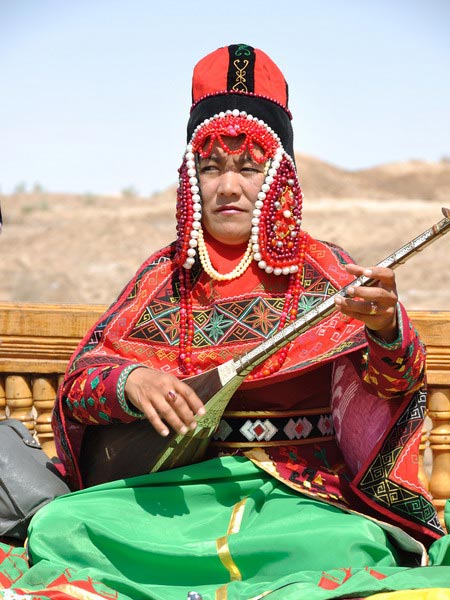
 Karakalpak musicTraditional Karakalpak music is multifaceted narration of poems and epics to the sound of traditional string bow instruments the qobuz (qobiz) and the duwtar (Dutar) and is closely connected with the oral folk tales and epics of their nomadic past.  It is transmitted by two key figures of this culture: the jiraw and baqsi both are poets, stortytellers and musicians at the same time. There traditional songs are divided into ritual kosiks: lullabies, funeral, wailing songs, wedding (synsu, bet ashar, korimlik). There's are also many love-lyric and historical songs in the national repertoire

The jiraw is a bard who specialises in heroic epics. He depicts in his singing, the courage and strength of heroes involved in titanic combats.
His narrative unfolds using a guttural tone and a deep voice reminiscent of the sound of his two-string fiddle, the qobiz. This instrument has a unique structure with two thick strings made from horse hair. The voice and the fiddle of the jiraw, as well as the content and values revealed in the epics  make an inimitable sound recreating the wild steepe of Central Asia.

As for the baqsi, there music stems from a rather different style. They sings epic poems, which instead celebrate courtly love, in a narrative style that describes the quest for love, either by an individual or a couple. The baqsi accompanies himself with a two-string lute, the duwtar (Dutar), while singing in a natural voice.
 
Jiraw (Throat singing) gained wide popularity from the end of the 18th century, when much of the most important Karakalpak literature and music was composed.

Such famous Karakalpak poets-musicians as Djien-zhirau (1730-1784), Kunkhodzhi (1799-1880) lived and worked during this period. They accompanied their stories with penetrating music trill, which gave a tragic, inimitable twist to their unique poems and epics. The Karakalpaks during most of the 18th -19th centuries were fighting for their independence from both the Kazakh and Khiva Khans. In this period the great tragedy unfolded as the Kazakh Khan Abulkhair pushed the Karakalpaks from the mid Syr Darya in the direction of Tashkent and Khorezm. A witness of these forced migrations, Jien-zhirau wrote the poem "The wandering nation", which reflected the darkest page of the history of the Karakalpak people.
The most famous exponent of baqsi during the 19th century was the national poet Ajiniyaz. His most famous works include "Buzatau", which tells of the Karakalpaks’ piligrimage and "Dzhigits" or in english "Other" which reflected his patriotic, humanistic and philosophical views.
 

Karakalpak musicAnother great Karakalpak baqsi was Berdymurad Kargabay ogly (known as Berdakh) who is justly considered to be a founder of the Karakalpak literature and was a noted baqsi singer much loved in his era. Berdakh regarded Navoi, Fuzuli, Kunkhodzhi as his teachers. His creativity began with the reading of verses to the tune of dombra, when he was 18 years old. Throughout his life he composed poems and runes on on mainly patriotic and historical themes.