Showing posts with label Kyzyl Kum. Show all posts

Friday, November 20, 2015

Kyzyl Kum "Desert"


In Uzbek: Qizilqum, In Kazakh:Qyzylqum (Қызылқұм) is the 16th largest desert in the world covering about 300,000 km2. Its name means Red Sand in Turkic languages. It is located in Central Asia in between the rivers Amu Darya and Syr Darya south east of the Aral Sea, a region historically known as Transoxania or Sogdiana. Today it is divided between Kazakhstan, Uzbekistan and (partly within) Turkmenistan. It consists of a plain sloping down toward the northwest, with a number of isolated bare mountains rising to a height of 922 m (Sultanuizdag) and several large enclosed basins. Precipitation,100–200 mm annually, occurs mainly in winter and spring.
 
Temperatures can be very high during the summer months, from mid-May to mid-September. The name Qyzlqum means Red Sand in Turkic languages. It is located in Central Asia in between the rivers Amu Darya and Syr Darya south east of the Aral Sea, a region historically known as Transoxania or Sogdiana. Today it is divided between Kazakhstan, Uzbekistan and (partly within) Turkmenistan. It consists of a plain sloping down toward the northwest, with a number of isolated bare mountains rising to a height of 922 m (Sultanuizdag) and several large enclosed basins. Precipitation, 100–200 mm annually, occurs mainly in winter and spring. Temperatures can be very high during the summer months, from mid-May to mid-September.Although the desert has no surface streams, there are abundant reserves of fresh underground water. Most of the desert lies in the middle subzone of the temperate zone deserts; in the south it borders on subtropical deserts. Soils are gray-brown and sandy, and solonets and solonchak are also found.
 
The vegetation cover is rich in ephemerals. Sand sedge, white saxaul, Ammodendron conollyi, and Salsola richteri are common on the sand ridges, and wormwood grows on the clayey hills. Thickets of Anabasis salsa and saltworts are found in the northwest, and in the valleys of dry riverbeds are black saxaul woodlands. The desert is inhabited by animals adapted to living without watering places, getting all or most of their water from their food. To decrease their need for water, many of them are nocturnal. The mammals are represented by the Persian gazelle, long-clawed suslik, large-toothed suslik, gerbil, jerboa, sand and steppe cats, wolves, corsac fox, and Cape hare. Birds include the crested lark, desert warbler, houbara bustard, and saxaul jay. There are also snakes (saw-scaled viper, levantine viper, sand boa, and arrow snake), lizards, and Horsfield’s terrapin.
 
Desert fauna include the Russian tortoise (Testudo horsfieldii) and a large lizard known as the Transcaspian or Desert Monitor (Varanus griseus), which can reach lengths of 1.6 m. The Saiga Antelope (Saiga tatarica) also occasionally migrates through the northern part of the desert.

The economy is based on a growing mining industry and livestock raising. Livestock are mainly fine-fleeced karakul sheep, bactrian camels and dromedaries. In the central and western parts of the desert large artesian basins have been discovered and are being exploited in many areas. As a result of irrigation many small oases have been created, which are the centers for livestock farms. The livestock feed off forage from salinity tolerant crops (halophytes) and watered from artesian wells.The Kyzyl Kum is well known for its deposits of gold, uranium, copper, aluminium and silver, natural gas and oil. Also marble, graphite, and turquoise are extracted. The development of most the famous gold-field at Muruntau began in the early 1970s. The centres for the mining and smelting industry in the region are Navoi, Zarafshan city, Uchkuduk. In addition important natural-gas deposits are exploited at Gazli in the southeast and processed at nearby industrial town of Mubarek.

Source: https://en.wikipedia.org/wiki/Kyzyl_Kum.


Thursday, September 18, 2014

La Forteresse d'Ayaz-kala


Forteresses d'Ayaz Kala 1 et 2 dans la république du Karakalpakstan et le désert de Kyzyl Kum en Ouzbekistan. Ayaz Kala 1 en haut est la plus ancienne (3e s. av. J.-C.). Ayaz Kala 2 est en dessous.


Video : Vue à partir de la forteresse de Ayaz Kala 1. French 1:12 


Friday, October 30, 2009

Neighbouring Regions of Karakalpakstan - Navoi


Navoi city is located 347 m. above sea level, on the left bank of the Zaravshan River 360 km. southwest of Tashkent (400 km.). Navoi city is the center of Navoi region.Most of the province is covered by the vast Kyzyl-kum desert. The population in 2004 was 825,000 people living in eight administrative districts with the main centres of population being Navoi City, Uchkuduck and Zerafshan.

The Navoi region like Khoresm and Bukhara also adjoins the Republic of Karakalpakstan

"Navoi" is named after the great Uzbek poet, philosopher and statesman Alisher Navoi and has a total area of 110 800 sq km or some 24,8% of the total land area of Uzbekistan.

Navoi today is one of the most industrially developed regions of Uzbekistan the economy being based on large mining, metallurgical and chemical industries. Including the Navoi Mining and Metallurgy Complex, OJSC “Navoiazot” the “JV JSC “Electrochemical factory” and JSC “Qyzylkumcement” (both centres of chemical production), JSC “UPP” (Construction materials), and OJSC "Navoi" (electric power). Currently there are some 40 industrial joint enterprises operating in Navoi with companies from China, Russia and South Korea predominating.

The agriculture sector is also important and includes the growing of cotton, grains, vegetables, watermelons, viticulture, astrakhan sheep and silkworms. There are also a number of food processing and textile plants.

Transport infrastructure is well developed: there are 8 rail stations, 3 airports and 4100km of developed roads. Navoi Airport is also now a major cargo hub for the Republic of Uzbekistan.

Sites to Visit
Whilst it does not have so many historical monuments as its neighbours its two parks Yujniy (South park)  is the favourite places among tourists and citizens.  Stadium, swimming pool and cinemas are located in this area. 

Near the City of Navoi in the town of Karmana is the beautiful Mirsaid Bahrom and Hanak Kasim Shayh mausoleums complexes, dating back to X-XVI centuries also nearby these are the ruins of Rabati Malik caravan-saray (XI century) once on the silk road.Also on the way to the town of Nurat (75 km away from Navoi town) is an ancient blacksmith forge from 15 c., and a system of wells dating to Middle ages.

In Nurat itself are found the ruins of the prayer house of Shaihul Nuri and the Spanjvakta Mosque built in 1582 by Emir Abdullah. The town also hosts the famous holy site "The Chashma mineral Springs". The Kasim Sheik mausoleum (X—XI centuries) is also located near the city.

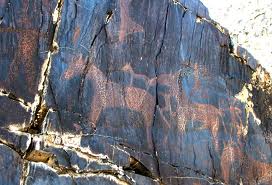
Nearby to Nurat are the beautiful and stark Nurat mountains in which many ancient rock inscriptions exist, dating to the bronze era which alone are worth coming to Navoi to visit. Numerous ancient rock paintings of people in strange clothes, some of which can be interpreted as images of "ancient astronauts" are found Sarmish gorge which is recognized as the largest canyon rock art gallery in the world. About four thousand of petroglyphs, which are engraved on the black shale are found in the area.