Showing posts with label gold. Show all posts

Wednesday, May 6, 2020

Muruntau gold mine


One of the most famous gold mines in the world is the Muruntau Mine, located in the northern part of the Kyzylkum desert in Navoi Rayon in Central Uzbekistan.  Every year, around two million ounces of gold are mined making it currently the highest producing gold mine in the world. The deposit was discovered in 1953, although ancient gold mines have since been revealed in the vicinity of the ore deposit. Detailed exploration took place between 1960 and 1965. Construction commenced in 1964, and mining in 1967, with the gold plant beginning operation two years later. The deposit originally contained more than 5400 tonnes (175 Moz) of gold at an open pit recovered grade of 3.4 g/t Au. 

Currently it is the largest open-pit gold mine in the world. Its length forms about 3 500 meters, and the width - about 2 700 meters and maximum  depth of the largest fracture is 600 meters which is planned to be extended beyond 1,000m. Even after decades of active gold mining, the mine's reserves form more than 1,750 tons of the precious metal.

Gold mining at Muruntau is conducted using a truck and conveyor ore transportation system. The overburden is taken to the crushing and trans hipping points using cyclic flow technology. The ore is transported using a steeply inclined  conveyor which can handle one million tonnes of ore per year (around 50,000 tonnes per day). Crushed ore is transported to the hydrometallurgical plant for refining and gold production. Gold is extracted using the heap leaching method that helps in efficient extraction of gold, even from low-grade ores. Sorption and filter-free process is used for extracting the gold. Also extracted is refined sliver and palladium by-product.

Source: https://www.mining-technology.com/projects/muruntau-gold-mine-uzbekistan/

Friday, October 30, 2009

Neighbouring Regions of Karakalpakstan - Navoi


Navoi city is located 347 m. above sea level, on the left bank of the Zaravshan River 360 km. southwest of Tashkent (400 km.). Navoi city is the center of Navoi region.Most of the province is covered by the vast Kyzyl-kum desert. The population in 2004 was 825,000 people living in eight administrative districts with the main centres of population being Navoi City, Uchkuduck and Zerafshan.

The Navoi region like Khoresm and Bukhara also adjoins the Republic of Karakalpakstan

"Navoi" is named after the great Uzbek poet, philosopher and statesman Alisher Navoi and has a total area of 110 800 sq km or some 24,8% of the total land area of Uzbekistan.

Navoi today is one of the most industrially developed regions of Uzbekistan the economy being based on large mining, metallurgical and chemical industries. Including the Navoi Mining and Metallurgy Complex, OJSC “Navoiazot” the “JV JSC “Electrochemical factory” and JSC “Qyzylkumcement” (both centres of chemical production), JSC “UPP” (Construction materials), and OJSC "Navoi" (electric power). Currently there are some 40 industrial joint enterprises operating in Navoi with companies from China, Russia and South Korea predominating.

The agriculture sector is also important and includes the growing of cotton, grains, vegetables, watermelons, viticulture, astrakhan sheep and silkworms. There are also a number of food processing and textile plants.

Transport infrastructure is well developed: there are 8 rail stations, 3 airports and 4100km of developed roads. Navoi Airport is also now a major cargo hub for the Republic of Uzbekistan.

Sites to Visit
Whilst it does not have so many historical monuments as its neighbours its two parks Yujniy (South park)  is the favourite places among tourists and citizens.  Stadium, swimming pool and cinemas are located in this area. 

Near the City of Navoi in the town of Karmana is the beautiful Mirsaid Bahrom and Hanak Kasim Shayh mausoleums complexes, dating back to X-XVI centuries also nearby these are the ruins of Rabati Malik caravan-saray (XI century) once on the silk road.Also on the way to the town of Nurat (75 km away from Navoi town) is an ancient blacksmith forge from 15 c., and a system of wells dating to Middle ages.

In Nurat itself are found the ruins of the prayer house of Shaihul Nuri and the Spanjvakta Mosque built in 1582 by Emir Abdullah. The town also hosts the famous holy site "The Chashma mineral Springs". The Kasim Sheik mausoleum (X—XI centuries) is also located near the city.

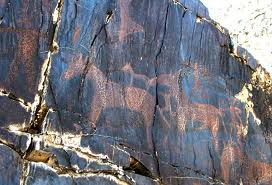
Nearby to Nurat are the beautiful and stark Nurat mountains in which many ancient rock inscriptions exist, dating to the bronze era which alone are worth coming to Navoi to visit. Numerous ancient rock paintings of people in strange clothes, some of which can be interpreted as images of "ancient astronauts" are found Sarmish gorge which is recognized as the largest canyon rock art gallery in the world. About four thousand of petroglyphs, which are engraved on the black shale are found in the area.